TL;DR
Four artists working with Brooklyn’s Genspace community biology lab presented work using natural pigments, algae yarn and compost clay at a three-day exhibition in Queens during Climate Week. The projects explore renewable and biodegradable materials, though the source does not establish their environmental impact or how widely they can replace conventional supplies.
Four artists working with Brooklyn’s Genspace community biology lab presented art made with natural pigments, algae yarn and compost clay at a three-day exhibition in Queens during Climate Week. The show, titled “Source Material: Genspace Biomaterials Studio BioArt Exhibit,” explored how locally rooted, renewable materials might change art-making, but the source does not report measurements of their environmental impact.

Get art and craft supplies delivered free with Prime
- Fast, free delivery on millions of items
- Prime Video, Amazon Music and more included
- Member-only deals all year
The exhibition took place at Flux IV in Queens and brought together artists from Genspace’s biomaterials studio. Its projects treated natural materials as sources of creative possibility, rather than simply as direct substitutes for store-bought synthetic supplies. The artists connected their work to local ecosystems, scientific inquiry and collaboration.
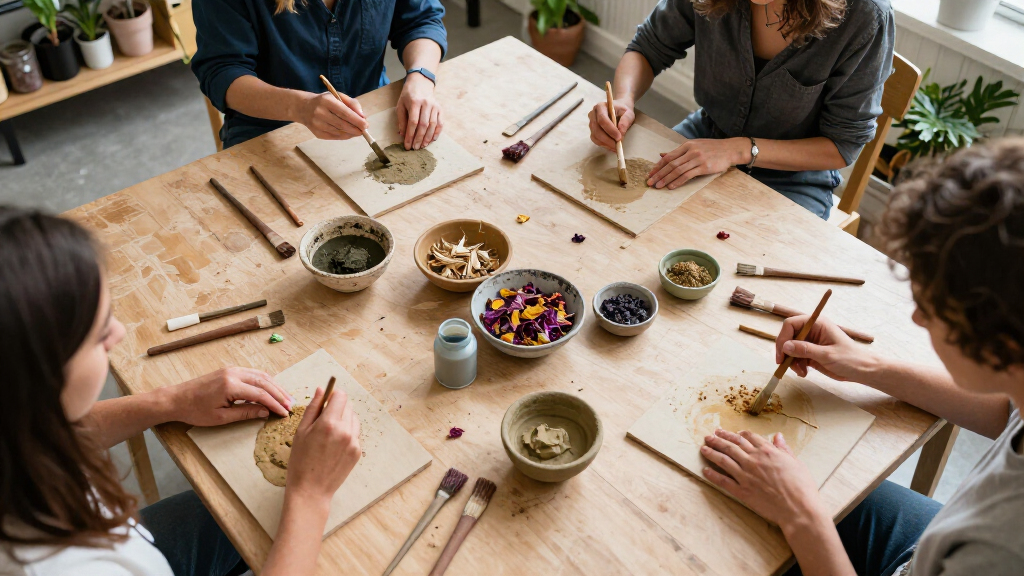
Becca Rodriguez’s “Puddle Pigments” (2026) used pigments made from mugwort, mulberry and serviceberry. The installation included paper, water samples, test tubes and video. Kaitlyn Gillums worked with compost clay, making bowls as well as bracelets and a belt buckle, according to the report.
The report identifies algae yarn as another material explored in the show, but the supplied account does not name the artist associated with that work or provide further project details. It introduces four artists, yet the available source material gives specific descriptions for only Rodriguez and Gillums. The other artists’ names, works and materials cannot be confirmed from that account.
Testing Materials Through Art
The exhibition offers a view of how artists are examining the materials behind their work. Pigments, yarn and clay are central to making objects and images; experimenting with their sources can prompt different methods and relationships to those objects. The artists’ approach, as described in the report, treats material choice as part of artistic practice rather than a simple purchasing decision.
That exploration is relevant amid broader concern about the climate emergency and the environmental effects of human activity. Still, the report documents an exhibition and artistic experiments, not a comparative assessment of conventional and bio-based supplies. It does not quantify emissions, waste, durability, cost or production scale, so the projects’ environmental advantages remain unmeasured in the material provided.
Popular right now

Vitamix 5200 Blender with 64 oz Container, Black

De'Longhi La Specialista Touch Semi-Automatic Espresso Machine with Grinder

Breville Barista Express Espresso Machine with Grinder, Black Truffle
As an affiliate, we earn on qualifying purchases.
From Local Sources to Studio
Before synthetic dyes and paint tubes developed in Europe during the 19th century, artists obtained color from plants, animals and minerals. The source report notes familiar natural colorants such as indigo, cochineal and turmeric, alongside many other organic sources. It also points out that some pigments and techniques carry cultural and symbolic meaning, including within Indigenous communities and artistic traditions across the Global South.
Genspace is described as a community biology lab in Sunset Park, Brooklyn. Its biomaterials studio brought artists’ material experiments into a public exhibition during Climate Week. The show’s focus was not limited to swapping one supply for another: the report presents natural materials as a way to reconsider creative processes and how people relate to art objects.
Questions About Scale and Impact
The source material does not say how the materials were sourced, processed or tested, or whether they are biodegradable under ordinary disposal conditions. It also provides no data comparing their environmental effects with those of synthetic supplies. Cost, durability, availability and scalability are not addressed, and the account does not give full details for two of the four artists it says took part.
The report describes the exhibition’s goals and artworks, but it does not establish that these materials can replace conventional supplies across art practices. Whether the experiments lead to further research, production or wider adoption is also unknown.
Further Work Beyond the Exhibition
The supplied report does not announce a follow-up exhibition, research project or timetable for developing the materials. For now, the documented next step is continued exploration by artists and collaborators working with local biological resources. Any assessment of the materials’ practical or environmental performance would require evidence beyond the exhibition account, including information about sourcing, manufacture, use and disposal.
Key Questions
What was “Source Material: Genspace Biomaterials Studio BioArt Exhibit”?
It was a three-day exhibition at Flux IV in Queens during Climate Week, featuring work by artists from Brooklyn’s Genspace biomaterials studio.
Which alternative art materials did the show feature?
The source mentions natural pigments, algae yarn and compost clay. It specifically describes Becca Rodriguez’s plant-based pigments and Kaitlyn Gillums’s compost-clay objects.
What pigments did Becca Rodriguez use?
Her work “Puddle Pigments” (2026) used pigments from mugwort, mulberry and serviceberry, presented with paper, water samples, test tubes and video.
Does the report show that these materials are better for the environment?
No comparative measurements are provided. The report describes the materials as renewable or biodegradable alternatives under exploration, but gives no data on their full environmental impact, disposal conditions or performance.
Source: rss