
TL;DR

Get art and craft supplies delivered free with Prime
- Fast, free delivery on millions of items
- Prime Video, Amazon Music and more included
- Member-only deals all year
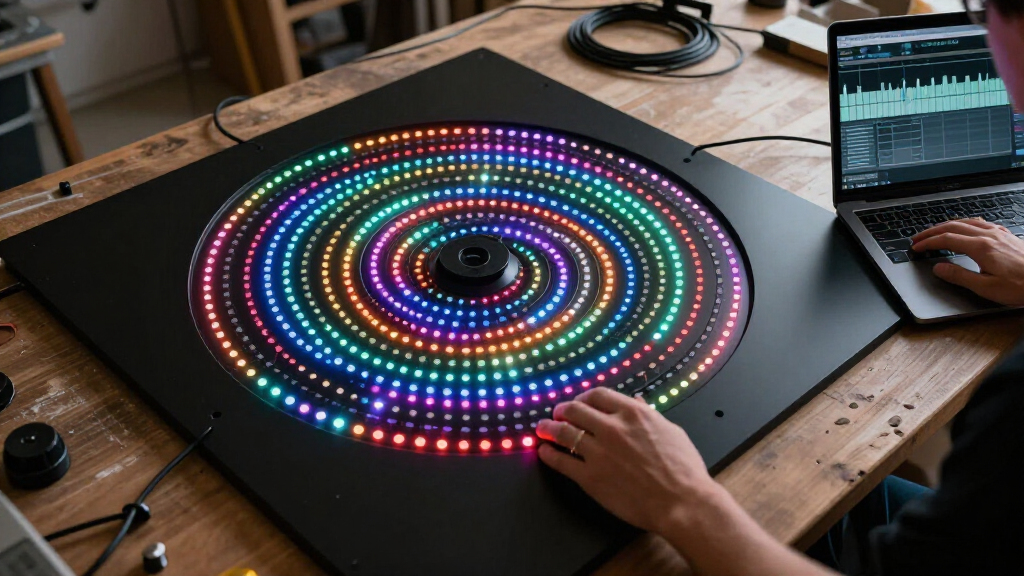
Artist and programmer Jagi Natarajan built Phyllotaxis, a 3D-printed, 89-cell LED display based on the spiral arrangement found in plants. An STM32 microcontroller analyzes microphone input and changes the LEDs’ brightness patterns in response to sound.
Jagi Natarajan has built Phyllotaxis, an 89-LED display whose cell layout draws on the spiral pattern seen in sunflower centers and other plants. In a project report, Natarajan describes how a microphone and an STM32 microcontroller let the display alter its light patterns in response to sound.
The project began as a digital study of phyllotaxis, the arrangement of leaves or seeds in spiral patterns. Natarajan used code to place points around a circle, rotating each point by an increasing multiple of the golden ratio. A Voronoi tessellation of those points created irregular, seed-like cells that could form the structure of a physical light.
Natarajan exported the cell boundaries from a Processing sketch and used the CadQuery library in Python to model the display. The design was divided into four quadrants to fit the available 3D printer bed. A separate faceplate, paper diffuser and screw holes were prepared using FreeCAD. Translucent mulberry paper was placed behind the cells, where it diffuses the LEDs’ light.
The finished array has 89 addressable LEDs, each installed in a cell. A spare STM32 Blackpill board controls them through a custom driver, while an INMP441 digital microphone supplies audio input. Natarajan used the ARM CMSIS library for signal processing, with automatic gain control and frequency-band analysis. The resulting program varies the lights in response to sound; one of the patterns Natarajan favored sends a pulsing brightness wave outward from the display’s center.
A Plant Pattern Becomes a Light Interface
Phyllotaxis shows how a mathematical pattern can guide both the shape and behavior of a physical object. The same radial layout that gives the display its plant-like appearance also provides coordinates for programming effects across its cells. That connection lets Natarajan treat the LEDs somewhat like pixels in a screen while working with a form that is not rectangular.
The project also demonstrates a compact approach to audio-reactive lighting: a microcontroller processes microphone data locally and uses the analysis to drive a custom array. Natarajan’s report describes a personal artwork and its construction, rather than a commercial product or a general performance benchmark. It does not establish how the design would compare with other audio-reactive systems.
From Digital Points to Printed Cells
Natarajan says the project grew from an interest in patterns found in nature and earlier experience building a rectangular NeoPixel matrix. The initial code arranged points along a radial line and rotated them by successive multiples of the golden ratio. Tessellating the point cloud turned that abstract arrangement into enclosed cells that could each hold an LED.
After printing the structure, Natarajan soldered the LEDs and tested them with basic patterns before adding audio input. The report describes the microphone as digital, which Natarajan chose to avoid analog noise in the microphone wiring. For the finished base, Natarajan routed a bamboo cutting board into a circle; the controller and microphone were mounted on a perfboard inside a 3D-printed enclosure with a guitar-pedal switch.
The Controller’s Final Reliability
The supplied report excerpt ends while describing the electronics, saying the controller and microphone were assembled on perfboard and that the electronics were “janky and prone to noise that would cause th”. The sentence is incomplete, so the reported noise problem’s cause, severity and eventual resolution are unclear. The material also does not give the display’s dimensions, power use, audio-analysis latency, or details about the frequency bands and gain-control settings.
Further Hardware Details Await
The source describes the audio-reactive program as the basis of what runs on the board, but the available excerpt does not state whether Natarajan later revised the electronics or published a final troubleshooting account. Further information about the noise issue, the completed enclosure and the display’s operating specifications would clarify how the build performs in regular use.
Key Questions
What is Phyllotaxis?
Phyllotaxis is Natarajan’s 89-LED display, named for the spiral arrangements found in plants such as sunflowers.
How does the display react to sound?
An INMP441 digital microphone sends audio input to an STM32 Blackpill microcontroller. The program analyzes sound energy across frequency bands and changes the LEDs’ patterns and brightness.
How was the display’s shape made?
Natarajan generated a radial point pattern in Processing, tessellated it into cells, then used CadQuery and FreeCAD to prepare printable parts. The structure was split into four quadrants to fit a 3D printer bed.
What remains unknown about the build?
The supplied report excerpt cuts off during a description of electronics that were prone to noise. It does not say how that problem was resolved or provide measurements such as power use, dimensions or response time.
Source: hn
Fall Picks
fall essentials
As an affiliate, we earn on qualifying purchases.