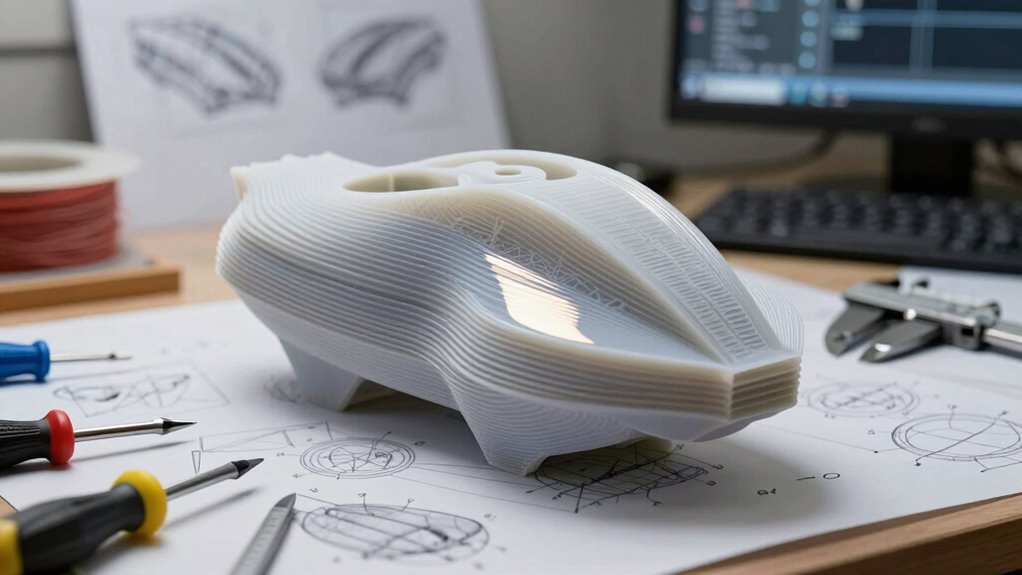

3D printer prototyping matters more than specs alone because it lets you see and feel your design in the real world. You can quickly identify flaws, test materials, and assess ergonomics or aesthetics early in development. This hands-on approach saves time and money, speeds up iteration, and reduces risks. By creating tangible models, you gain insights that specs can’t provide. Keep exploring, and you’ll discover how these benefits can give your project a real edge.
Key Takeaways
- Prototypes enable hands-on testing to identify ergonomic, aesthetic, and functional issues early, beyond what specifications reveal.
- Rapid iteration with 3D printing allows quick modifications, speeding up development compared to relying solely on specs.
- Physical models demonstrate real-world material behavior and performance, which specs alone cannot fully predict.
- 3D printed prototypes facilitate practical testing, uncovering flaws before costly production steps.
- Prototyping supports innovation and risk reduction by providing tangible insights that specs alone cannot provide.
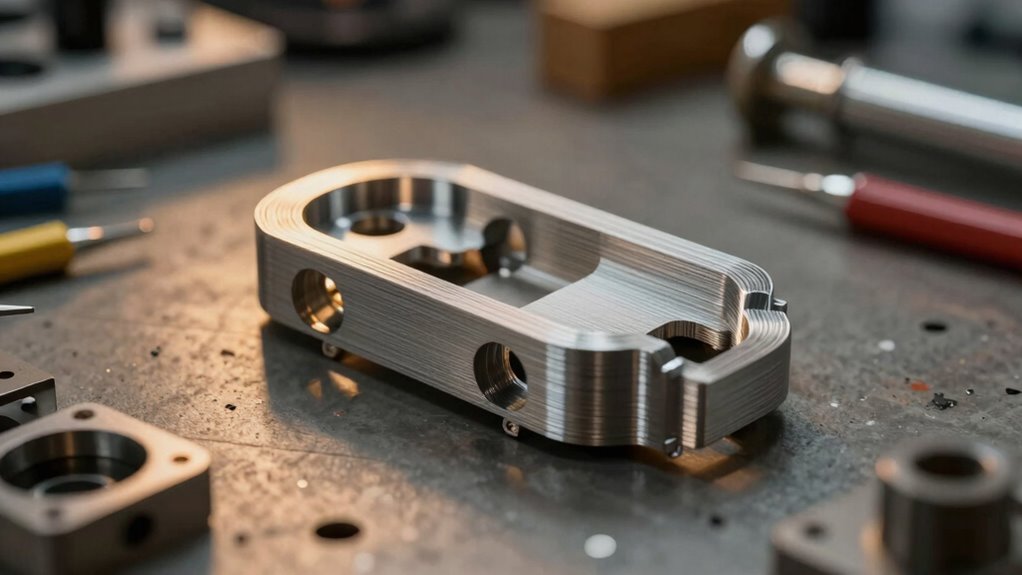
3D printer prototyping has become a crucial step in product development because it allows you to quickly turn ideas into tangible models. This process gives you the ability to evaluate and refine your designs early, saving both time and resources. One of the key advantages is material versatility. With 3D printing, you’re not limited to a single type of material; instead, you can choose from plastics, resins, metals, and composites, depending on your project’s requirements. This flexibility means you can create prototypes that closely mimic the final product’s properties, whether you need durability, flexibility, or heat resistance. By experimenting with different materials, you gain a better understanding of how your design performs under real-world conditions, which is difficult to achieve with traditional prototyping methods. Additionally, understanding material properties is essential for selecting the right material for your specific application. Recognizing the importance of material testing helps ensure your prototypes accurately represent the final product’s performance. Incorporating material behavior insights allows for more precise predictions of how the final product will perform in real-world scenarios. Moreover, gaining insights into material performance can inform future material choices for large-scale production, making your prototypes even more valuable. Understanding material compatibility is also vital for selecting the appropriate printing processes and ensuring successful prototype fabrication.
Cost efficiency is another critical benefit that makes 3D printer prototyping so valuable. Traditional prototyping often involves expensive molds, tooling, or manufacturing setups, which can quickly escalate costs, especially during early-stage development. In contrast, 3D printing allows you to produce prototypes on demand and in smaller quantities, drastically reducing expenses. You don’t need to invest in expensive tooling or large-scale manufacturing; instead, you can print just what you need for testing and evaluation. This approach enables rapid iteration, so you can identify potential flaws and make improvements without breaking the bank. The ability to swiftly modify and reprint prototypes accelerates your development cycle, giving you a competitive edge.
However, material versatility and cost efficiency only matter if you recognize that 3D printer prototyping offers more than just specs on paper. It provides a tangible, hands-on experience that reveals insights no digital model can offer alone. Seeing and handling a physical prototype helps you identify ergonomic issues, aesthetic concerns, and functional flaws early, before committing to costly production steps. Relying solely on specs might suggest that your design is perfect, but it doesn’t account for real-world variables like material behavior or user interaction. 3D printing bridges this gap, transforming your conceptual ideas into real-world prototypes that can be tested and refined.
In essence, 3D printer prototyping matters because it combines material versatility and cost efficiency with practical, real-world insights that specs alone can’t provide. It’s a powerful tool that supports innovation, reduces risk, and streamlines your path from concept to final product.

250g PLA Filament 1.75mm Bundle, SUNLU 3D Printer Filament Neatly Wound, Individually Vacuum Packed, 250g Spool, 8 Rolls, White+Red+Orange+Yellow+Green+Blue+Cyan+Purple
- Ideal for Beginners: Compact 250g mini spools for testing
- Multiple Colors Included: White, Red, Orange, Yellow, Green, Blue, Cyan, Purple
- High-Quality PLA Material: Low melting point, minimal warping, glossy finish
As an affiliate, we earn on qualifying purchases.
As an affiliate, we earn on qualifying purchases.
Frequently Asked Questions
How Cost-Effective Is 3D Printing for Prototyping?
3D printing is highly cost-effective for prototyping because it offers material versatility, allowing you to choose the best material for your project without extra costs. It reduces waste and speeds up production, saving you money on traditional methods. Plus, you can quickly iterate designs, avoiding expensive tooling. Overall, 3D printing provides a flexible, budget-friendly way to develop prototypes efficiently, making it a smart choice for cost-conscious creators.
What Materials Are Best for Functional 3D Prototypes?
You might think fancy materials are the way to go, but for functional prototypes, durability and surface finish are king. ABS and PETG are your reliable friends—strong, impact-resistant, and easy to work with. Nylon and polycarbonate also shine, offering superb strength and heat resistance. Remember, the best material balances durability with a smooth surface finish, ensuring your prototype not only works well but also looks professional enough to impress.
How Does Prototyping Speed Impact Product Development?
Prototyping speed directly impacts your product development by enabling quicker design iterations and more frequent user feedback. When you produce prototypes faster, you can identify flaws early, refine features, and adapt to user needs efficiently. This rapid cycle accelerates innovation, reduces time to market, and guarantees your final product better aligns with customer expectations. Fundamentally, faster prototyping keeps your development process agile and responsive.
Can 3D Prototypes Accurately Test Real-World Performance?
Like Icarus testing his wings, you can’t rely solely on 3D prototypes to mirror real-world performance. While they excel in material accuracy and quick testing, they may fall short in testing reliability under extreme conditions. These prototypes give you valuable insights, but for true performance validation, you still need to move beyond initial models and test with actual materials and environments.
What Are Common Challenges in 3D Printing Prototypes?
You’ll face challenges like design iteration setbacks, where prototypes don’t meet your expectations, prompting multiple revisions. Material limitations can restrict your choices, making it hard to replicate final product properties accurately. Inconsistent print quality or layer adhesion issues may also arise, causing delays. These hurdles require patience and flexibility, but overcoming them helps refine your design and guarantees the final product performs well in real-world applications.

ELEGOO ABS-Like 3.0 3D Printer Resin Grey 2000g
- High Strength and Toughness: Resistant to impact and deformation
- High Precision & Low Shrinkage: Ensures detailed and accurate prints
- Good Fluidity for Fast Curing: Low viscosity for quicker printing
As an affiliate, we earn on qualifying purchases.
As an affiliate, we earn on qualifying purchases.
Conclusion
You see, 3D printing isn’t just about specs or shiny new tech—it’s your creative compass guiding ideas from mind to masterpiece. Think of it as a sculptor’s chisel, carving out imperfections and revealing the true shape of your vision. When you embrace rapid prototyping, you’re not just building models; you’re shaping the future of your innovation. So don’t just chase specs—let your prototypes tell the story of what’s possible, one layer at a time.

Protopasta Ferromagnetic Iron PLA 3D Printer Filament | ProtoPlant Metal-Filled PLA Plastic Printer Filament with 45% Iron | Patina Friendly Metal Composite Filament | 500g Metallic Spool
- Metal Infused Composition: Contains 45% iron powder for a metal look
- High Density and Ferromagnetic: Twice the density of standard PLA, magnets stick to it
- Versatile Metallic Finish: Creates realistic, patina-ready metallic surfaces
As an affiliate, we earn on qualifying purchases.
As an affiliate, we earn on qualifying purchases.

Original Prusa CORE One, Ready-to-use 3D Printer, Assembled and Tested, Removable Print Sheets, 1kg Prusament PLA Spool Included, Print Size 9.8 x 8.6 x 10.6 in
- Durable and Reliable Design: Made from premium materials for longevity
- Enclosed Temperature-Controlled Chamber: Reaches up to 55°C for versatile materials
- Wide Material Compatibility: Supports PLA, PETG, ASA, PC, Nylon
As an affiliate, we earn on qualifying purchases.
As an affiliate, we earn on qualifying purchases.