
TL;DR

Get art and craft supplies delivered free — and shop member deals
- Fast, free delivery on millions of items
- Access to Prime Big Deal Days deals on October 6–7
- Prime Video, Amazon Music and more included
DIY Halloween costume kits bundle some of the materials needed to make a costume, such as fabric pieces, patterns, or accessories, while leaving room for you to assemble and personalize the look. Before buying, check the contents, sizing, skill level, safety notes, and total cost—including missing supplies—and allow time to assemble, adjust, and try on the finished costume.
Halloween plans can sneak up on you: one minute your child wants to be a moonlit bat, and the next you’re staring at a pile of black fabric, glue, and a calendar with three days left. A DIY Halloween costume kit can give you a head start by bundling selected materials, but it still asks you to make and fit the costume yourself.
These kits range from simple craft sets with felt shapes and elastic to more involved projects with patterns, fabric, and several assembly steps. They can make a fun family activity, help you personalize a familiar look, and leave you with pieces for future dress-up. They can also leave out scissors, glue, clothing, or other supplies you assumed were in the box.
This guide shows you what kits usually include, how to estimate the real cost and time, and what to check for fit, comfort, and safe use. You’ll be better prepared to pick a project you can finish before the candy bowl comes out.
Read the full contents list: many kits omit clothing, glue, scissors, thread, or other tools.
Compare the kit price plus missing supplies with a ready-made costume and what you already own.
Match the project’s age guidance, skill level, and making time to your household’s schedule.
Try on the full costume in the intended clothes and shoes; check visibility, breathing, movement, and secure pieces.
Save useful capes, hats, and fabric for future dress-up, and check local rules before recycling craft leftovers.
Know what a DIY Halloween costume kit really includes
A DIY Halloween costume kit is a bundle of selected materials or instructions that helps you make a costume, but it rarely means every part of the finished outfit comes in one box. The contents can include fabric pieces, patterns, accessories, decorations, or face paint; some sets supply only templates or a few signature parts. Read the item list before you count on it for a complete look.
For example, a child’s bat kit might include felt wings, a headband, and elastic, while expecting you to provide a black shirt and trousers. A more ambitious sewing kit could include a pattern and measured fabric, but leave out thread, needles, and scissors. The product photos may show a finished costume, so look for a written contents list that explains what you’ll actually unpack.
The distinction matters because the kit’s value depends on how well its contents match what you already have. If you own the basics, a few signature pieces may save shopping time and make an easy project. If you need to buy the clothes and tools too, the kit may be only one part of a larger purchase. Missing materials can also affect timing: a specialty color of fabric or a particular fastener may take longer to find than the kit itself.
The word “kit” can cover very different amounts of work. A simple mask-and-cape set may take one short sitting; a costume that needs cutting, stitching, or paint to dry can stretch across an evening or two. Look for the recommended age, skill level, and time estimate, and treat an estimate as a starting point rather than a guarantee. The time required influences more than convenience: a project with several steps may offer more room to personalize, but it also leaves less flexibility if a piece needs refitting.
Imagine planning a robot costume around a silver chest panel, then discovering that the kit doesn’t include the shirt or straps to hold it on. The panel may still be useful, but the missing pieces change your shopping list and how the costume sits on the wearer. A quick contents check can spare you that last-minute scramble and help you judge what the kit really saves you from having to find.
DIY Halloween costume kit for kids
As an affiliate, we earn on qualifying purchases.
As an affiliate, we earn on qualifying purchases.
Choose a kit that matches your maker’s age, skill, and schedule
The right DIY Halloween costume kit matches the person making it, the person wearing it, and the time available before Halloween. Check the age guidance, assembly steps, and stated time before you buy; a bright picture on the package won’t tell you whether the project needs careful sewing or adult supervision. A beginner-friendly project can still have fiddly parts, and those can turn a short activity into a frustrating one if the maker is expected to manage them alone.
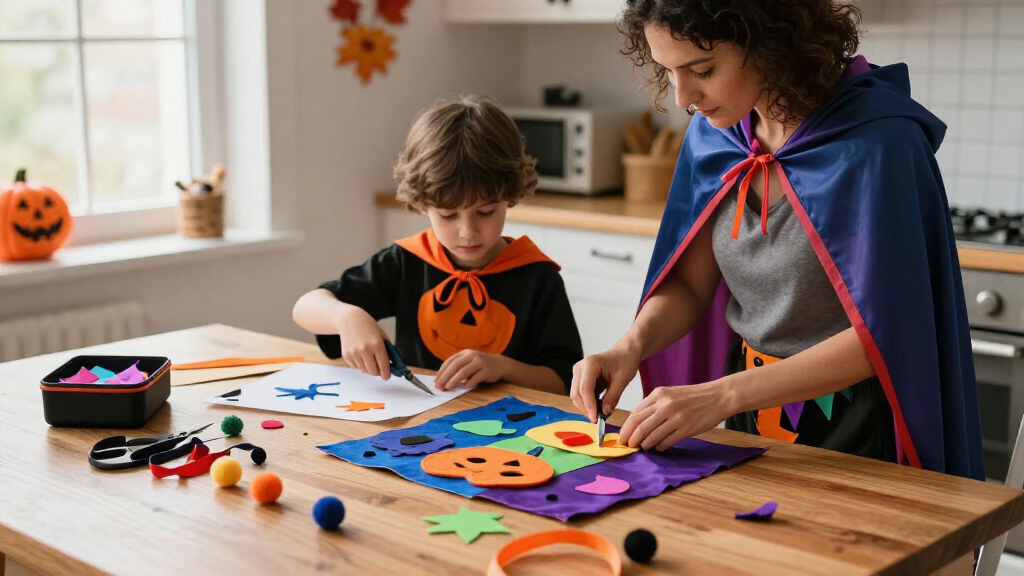
For a first family project, think about what a seven-year-old can comfortably do: sort felt pieces, choose colors, and place decorations with help. An adult can handle cutting and any close-fitting adjustments. Sharing the work this way lets the child participate without making precision tasks the bottleneck. A teenager who likes making things may enjoy following a pattern or customizing a cape, especially if they have a couple of evenings to work.
Use the listed making time as a baseline and leave room for fitting, glue or paint drying, and small corrections. If the instructions say two hours, don’t start at bedtime the night before a school parade. A piece that seems simple on a table can sit differently on the wearer, and a strap may need moving once they walk around. That buffer is useful because rushed fixes can affect both comfort and how securely the costume stays in place.
A practical way to choose is to check these four things before ordering:
- Skill: Match the steps to what the maker can do or safely learn. More challenging techniques may be rewarding, but they need room for mistakes and help.
- Time: Add a buffer for drying, adjustments, and a full try-on. A tight deadline favors fewer steps and materials that are ready to use.
- Help: Check whether an adult needs to do any cutting or tool work, and plan for that person’s availability.
- Interest: Let the wearer choose at least one color or detail, so the project feels personal and they are more likely to enjoy wearing it.
For instance, a child who loses interest after ten minutes may prefer a quick animal mask over a multi-piece armor set. The more elaborate set might offer greater creative involvement, but only if the family can spread the work over enough sessions. The best kit is the one you can finish happily, with enough energy left to enjoy wearing it.
Halloween costume craft kit with fabric and accessories
As an affiliate, we earn on qualifying purchases.
As an affiliate, we earn on qualifying purchases.
Compare the full price with a ready-made costume
A DIY Halloween costume kit can save time on finding supplies, but it is not automatically cheaper than a finished costume. Compare the kit price plus missing materials and tools with the ready-made price, and include the clothes worn underneath. The total can change once you account for all the pieces needed to make the look work. Think of the kit price as the starting point, not the final cost.
Say a kit costs $24 and includes a cape, felt emblem, and instructions. If you also need a $12 shirt, $5 for fabric glue, and $4 for elastic, your project reaches $45 before you count your time. A ready-made outfit on sale for $38 may cost less, while a version assembled from clothes already in your closet could keep the kit route affordable. The closet matters because those clothes have a cost only if you need to buy them for this project; supplies left over may have value if you’ll use them again.
Use a simple comparison before checkout:
| Cost or factor | DIY kit | Ready-made costume |
|---|---|---|
| What you pay for | Kit plus any missing supplies and clothing | Finished outfit, with possible extra accessories |
| Time | Assembly, drying, fitting, and corrections | Usually unpacking and trying it on |
| Personal touches | Often easy to adjust with extra decorations | Depends on the design and material |
| Reuse | Some capes, hats, and craft supplies may work later | Some pieces may also become dress-up clothes |
The rows point to different kinds of value, so the lowest price may not be the best fit. Assembly takes time, but it can buy you customization and a project to do together. A ready-made outfit usually reduces work and uncertainty, but it may offer fewer options for adjusting the details. Reuse can make either choice more worthwhile, provided the pieces are durable and your household will actually use them again.
Picture a family that already owns black leggings and a sweatshirt. Adding a kit’s bat wings may be a quick, low-cost solution; buying a complete bat costume could mean paying for duplicate basics. But if you need to buy nearly every part and only want the outfit for one night, a ready-made option might offer better value. Your closet, budget, and available time decide the answer.
Halloween costume making supplies bundle
As an affiliate, we earn on qualifying purchases.
As an affiliate, we earn on qualifying purchases.
Personalize the costume without making the project harder
A DIY Halloween costume kit gives you a ready-made starting point and often leaves room for personal touches. You can change colors, add decorations, or pair kit parts with clothing you already own, as long as your choices keep the costume wearable. Small, thoughtful changes can make two costumes from the same bundle feel completely different. The useful tradeoff is to add character without adding so many steps that the project becomes difficult to finish.
For example, siblings could start with matching wizard capes, then choose different patches: one picks a silver moon, the other a copper star. A plain pumpkin set could turn into a glowing garden costume with green sleeves and leaf-shaped felt from a scrap bin. These details let the wearer take part without requiring you to redesign the whole project; using materials on hand can also keep the added cost and shopping time down.
Keep a boundary between decoration and function. Extra fabric can snag if it trails near the feet, and bulky add-ons can make it harder to sit or climb stairs. Before attaching a new piece, ask the wearer to walk, turn, sit, and raise their arms. If the costume rides up or blocks their movement, simplify the decoration or reposition it. A detail that looks striking while standing still may not be worth keeping if it makes the costume uncomfortable in use.
Some kits are marketed around licensed characters or recognizable themes; others use generic shapes and colors. Licensed designs can deliver a familiar look straight from the package, while generic sets may give you more freedom to invent a character. Seasonal product choices change by retailer and year, so don’t assume a particular kit will be available later. If your child has a favorite idea, buying early gives you more time to add a matching detail from home.
The enjoyable part may be the making as much as the reveal. A rainy Saturday with felt scraps spread across the table can turn a costume into a shared memory—provided the project stays manageable. Choosing one or two details in advance helps keep the work focused while giving the wearer a visible role in shaping the result. What small detail would make the wearer grin when they catch their reflection?
Halloween costume sewing pattern kit
As an affiliate, we earn on qualifying purchases.
As an affiliate, we earn on qualifying purchases.
Check comfort and safety before the first trick-or-treat stop
A costume is ready when the wearer can see, breathe, walk, and move freely, not just when it looks finished on a hanger. Check the kit’s age and small-parts warnings, follow directions for paints and adhesives, and test the full outfit before Halloween. A quick try-on at home can reveal a scratchy seam or slipping mask while you still have time to fix it. These checks matter because discomfort or blocked vision can turn an otherwise successful costume into something the wearer cannot comfortably use outdoors.
Have the wearer put on the costume with the clothes and shoes they plan to use outside. Ask them to look to each side, walk up and down a hallway, sit in a chair, and lift both arms. If a hood covers their vision or a cape drags under their shoes, adjust it. Think about weather too: a thin costume over a coat may fit differently than it did over a T-shirt. Testing the full combination helps catch problems that a mirror check in indoor clothes might miss.
Follow labels for face paint and adhesives, especially near the eyes or on sensitive skin. A small patch test can help you spot a reaction before a long evening out, though the product directions should guide how to use it. Keep small decorations away from very young children who may put them in their mouths, and use blades, hot tools, or other craft equipment only with suitable adult supervision. The kit’s age guidance is a starting point for choosing an activity; the wearer’s needs and the actual steps still determine what supervision is appropriate.
Consider a child in a shiny robot costume heading along a dim sidewalk. If the box panels block their peripheral vision or a loose strap catches on a step, the costume needs adjusting before the outing. Panels may need to be cut back or secured differently, and visibility should take priority over preserving the exact product-photo shape. Simple checks—clear sightlines, secure pieces, and room to take a normal stride—help keep the fun going from the front porch to the last house.
A costume should move with its wearer. If they can’t see the path, take a full step, and raise their arms, keep adjusting before you head out.
Make a small kit last beyond Halloween night
Some DIY costume kit pieces can live on after Halloween as dress-up clothes or supplies for another craft. Capes, hats, sturdy masks, and leftover fabric may be useful again, while mixed-material decorations can be harder to recycle. Save the parts that remain clean and wearable, and check your local recycling guidance before putting craft scraps in a bin. Reuse can stretch the value of a kit, but only when saving an item is more useful than storing something nobody will reach for.
After a school party, for instance, a fabric cape can become part of a rainy-day superhero game, while a cardboard robot panel may be too bent to keep. Store reusable pieces in a labeled bag or box so they don’t disappear under next season’s decorations. Keeping the original instructions with the saved parts can help you repair a loose fastening later. Choosing what to keep based on durability and likely play makes storage more manageable than saving every scrap.
Reuse also affects how you judge value. A kit that costs a little more might make sense if its plain accessories can support several play ideas; a one-night decoration set may be less appealing if it can’t be repurposed. That doesn’t make either choice wrong. Think about what your household already uses, what fits in your storage space, and whether the pieces will actually come out again. A theoretical second use does not offset a higher price if the costume is likely to stay in its box.
If you’re ordering online, leave enough time for delivery, assembly, and a test fit. Seasonal selections can change quickly, and return rules may differ, so check the seller’s policy and inspect the contents soon after arrival. If something is missing or doesn’t fit, you’ll have more time to ask the seller about it or find a simple replacement. A costume that gets worn again starts with a plan for keeping its best pieces in reach.
Frequently Asked Questions
What is included in a DIY Halloween costume kit?
It depends on the kit: some include fabric pieces, patterns, accessories, or decorations, while others provide only templates or a few signature parts. Check the item list for supplies like clothing, glue, scissors, thread, and batteries that may be sold separately.
Is a DIY costume kit cheaper than buying a finished costume?
Sometimes, but the kit price alone won’t tell you. Add the cost of missing materials, tools, and clothes you need to buy, then compare that total with a ready-made outfit or items you already own.
Are DIY Halloween costume kits suitable for beginners and children?
Many kits suit beginners, but difficulty and supervision needs vary. Review the recommended age and steps first; a child can often choose colors and decorations while an adult handles cutting or other tasks called out in the instructions.
How long does it take to make a costume from a kit?
Timing depends on the design, your experience, and whether paint or glue needs to dry. Allow extra time for fitting and corrections, and try the completed outfit on before the day you plan to wear it.
Can I customize a costume kit?
Usually. You can often change colors, add decorations, or combine the kit parts with clothes you already own, as long as the changes leave the costume comfortable and easy to move in.
How do I make a costume comfortable and safe?
Have the wearer try on the whole outfit with their intended shoes and clothing, then check that they can see, breathe, walk, sit, and raise their arms freely. Follow labels for face paint and adhesives, check small-parts warnings, and adjust loose or trailing pieces before going out.
Conclusion
Choose a kit by checking what it includes, what it leaves out, and whether you have enough time to assemble and test it. A clear contents list, realistic budget, and full try-on do more for Halloween night than a perfect product photo.
Then add one detail the wearer chose themselves. A silver moon, a crooked felt grin, a cape that swishes past the knees—that’s the part they’ll remember when the last candy wrapper rustles.
Halloween Picks
halloween
As an affiliate, we earn on qualifying purchases.