
TL;DR

Get art and craft supplies delivered free — and shop member deals
- Fast, free delivery on millions of items
- Access to Prime Big Deal Days deals on October 6–7
- Prime Video, Amazon Music and more included
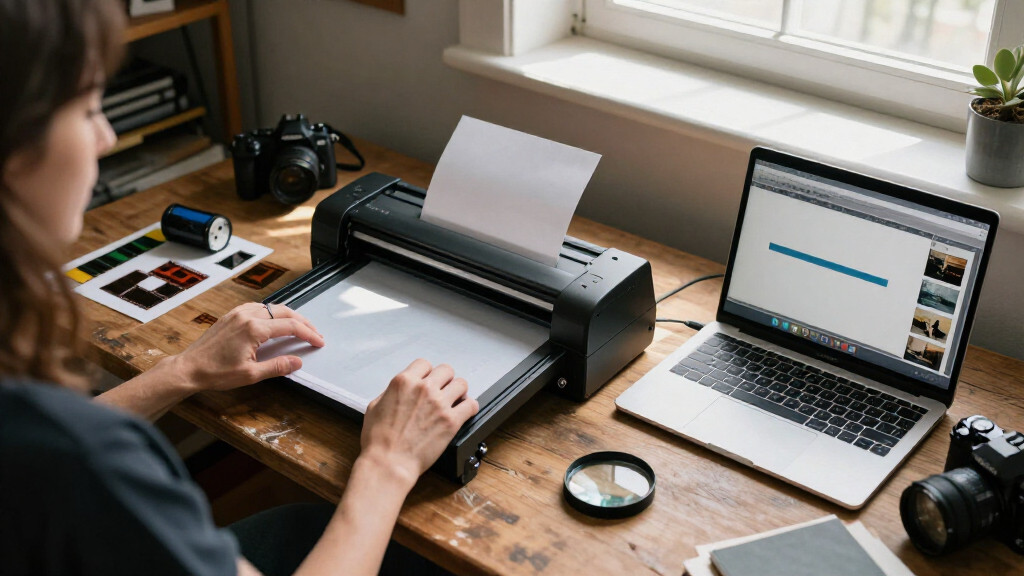
Shan Hannadige has created an end‑to‑end automated workflow for 35 mm film scanning that uses open‑source drivers, VueScan and AI models to handle scanning, color conversion and dust removal. The system replaces a four‑hour manual process with a largely hands‑free pipeline, though long‑term reliability remains untested.
Shan Hannadige announced that he has built a fully automated pipeline that scans, converts and cleans 35 mm film negatives using AI tools, eliminating most of the manual steps that previously took him about four hours per roll.
The automation begins with SANE, an open‑source scanner driver stack, which now runs under control of Claude, an AI assistant. After initial trials caused a mechanical jam, Hannadige repaired the scanner and reconfigured SANE to correctly handle carriage movement. The scanner is operated via VueScan, the software he had licensed for years because of its compatibility with his hardware.
Once raw scans are captured, a custom NumPy routine inverts the negatives into positives, applying density‑based color correction across the whole roll. Hannadige’s code uses the blank leader slot as a reference point to weight the correction, ensuring consistent tones without over‑correcting individual frames.
A second AI component, the LaMa inpainting model, addresses dust and scratches detected by image analysis. The detection algorithm first flags potential defects; it then filters out false positives—such as sun glints on water—by checking surrounding pixel smoothness before applying LaMa to fill the spots with context‑aware detail.
Impact on Personal Photo Digitization
This automation matters because it dramatically reduces the time and physical effort required for analog photographers to create digital archives. By moving from a four‑hour manual workflow to an almost hands‑free process, Hannadige can digitize more rolls before the film degrades, preserving memories that might otherwise be lost. The use of open‑source drivers and freely available AI models also demonstrates a low‑cost path for hobbyists to modernize analog workflows without purchasing expensive commercial solutions.
35mm film scanner with AI dust removal
As an affiliate, we earn on qualifying purchases.
As an affiliate, we earn on qualifying purchases.
From Manual Lab to Automated Workflow
Hannadige’s original process involved loading film, sending it to a lab, picking up the developed negatives, cutting them into strips, manually feeding each strip into a scanner, then opening every file in Darktable for inversion and editing. As his collection grew, this routine became unsustainable, prompting him to explore automation in early 2026.
Initial attempts to let Claude drive the scanner directly resulted in a hardware failure that required manual repair of the carriage gear. After fixing the mechanical issue, he shifted focus from automating the physical loading to automating the digital post‑processing steps, which proved more reliable and easier to script.
“The genesys backend sends the carriage back with a blind reverse move… it assumes the carriage travelled forward during the scan. That’s why the motor was driving into its end stop.”
— Claude, AI assistant (chat log Sep 20 2026)
automatic film negative scanner VueScan
As an affiliate, we earn on qualifying purchases.
As an affiliate, we earn on qualifying purchases.
Open Questions About Long‑Term Reliability
While the pipeline works for the test rolls Hannadige processed, it is not yet clear how it will handle larger batches or different film stocks with varying grain structures. The durability of the repaired scanner under continuous automated operation has not been fully evaluated, and the dust‑detection algorithm may still produce false positives on highly textured images.
film negative cleaning AI software
As an affiliate, we earn on qualifying purchases.
As an affiliate, we earn on qualifying purchases.
Future Enhancements Planned
Hannadige plans to integrate a robotic arm for automatic film loading, which would eliminate the remaining manual step of placing strips into the scanner. He also intends to open‑source his NumPy conversion scripts and LaMa dust‑removal pipeline on GitHub, inviting community contributions to improve robustness across diverse film types.
As an affiliate, we earn on qualifying purchases.
Key Questions
How much time does the automated pipeline save per roll?
Hannadige reports that the hands‑free scanning and processing now takes roughly 45 minutes per 36‑frame roll, compared with the previous four‑hour manual workflow.
Do I need specialized hardware to replicate this setup?
No. The system uses a standard flatbed scanner compatible with VueScan, the open‑source SANE driver stack, and a consumer‑grade computer capable of running Python, NumPy and LaMa models.
Can the pipeline handle color slide film as well as black‑and‑white negatives?
The current implementation focuses on black‑and‑white negatives; adapting it for color slides would require additional color‑profile calibration, which Hannadige plans to explore in future updates.
Is the source code available for public use?
Hannadige intends to publish his conversion and dust‑removal scripts on GitHub after final testing, making them freely accessible under an open‑source license.
What are the risks of using AI models like LaMa for dust removal?
AI inpainting can occasionally introduce artifacts if the surrounding texture is complex. Hannadige mitigates this by limiting LaMa to areas confirmed as dust through contextual analysis, but users should review outputs before final archiving.
Source: hn
Evergreen bestsellers Picks
bestsellers
As an affiliate, we earn on qualifying purchases.