
TL;DR

Get art and craft supplies delivered free with Prime
- Fast, free delivery on millions of items
- Prime Video, Amazon Music and more included
- Member-only deals all year
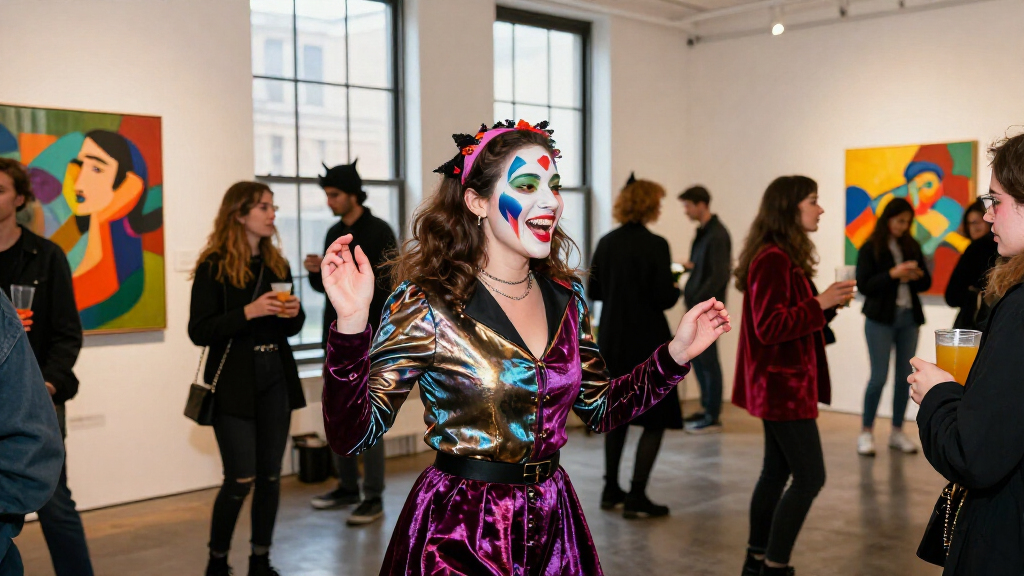
Hyperallergic held its annual art costume party on October 28 at Oberon in Brooklyn, drawing nearly 200 members, readers, artists and guests. Its costume contest recognized references ranging from Francisco Goya’s prints to the performance work of Las Yeguas del Apocalipsis; the event report does not give a full list of category winners.
Hyperallergic’s annual art costume party brought nearly 200 people to Oberon in Brooklyn on October 28, with costumes inspired by art history, performance and the art world. In its report, the publication identified contest winners including Emilio Rojas and Chico Raro, who dressed as figures from Las Yeguas del Apocalipsis’s 1989 work Las Dos Fridas, and Melissa Brown and Marie Lorenz, whose “Beast Jesus” pairing won the People’s Choice award.
Hyperallergic said attendees included its members, readers, artists, supporters and their friends. The contest featured categories such as “Best in Show,” “Most Esoteric” and “Most Likely to Get Censored in Florida.” The report names winners and highlights several costumes, although it does not present a complete results list for every category.
Rojas and Raro won Best in Show as Pedro Lemebel and Francisco Casa Silva of Las Yeguas del Apocalipsis, the Chilean art collective whose work the report dates to 1989. Zoë Lescaze and Michael Rossi were among the Most Esoteric winners; Hyperallergic said they made their costumes from scratch, including a chair, to represent less familiar characters from Francisco Goya’s Los caprichos (1797–98).
The People’s Choice award went to Brown and Lorenz, who portrayed the widely discussed restoration of Ecce Homo, nicknamed “Beast Jesus,” and restorer Cecilia Giménez Zueco. Other featured interpretations included George Grosz’s antifascist Eclipse of the Sun (1926), recreated by staff and curators from the Heckscher Museum of Art, and a costume based on Richard Prince’s Wayward Nurse (2005).
Art History Became Partywear
The party offered a lively, participatory way to encounter art history: guests translated paintings, sculptures, performance works and artists’ ideas into wearable costumes. The mix of familiar images and more obscure references also made the event a snapshot of how an art audience draws on shared knowledge, from Vermeer and Roy Lichtenstein to Goya and Eva Hesse.
Some costumes carried meanings beyond visual recognition. The Heckscher Museum group chose a work described by Hyperallergic as antifascist, while the Prince-inspired entry referenced a series about the sexualization of nurses on pulp-fiction book covers. The report’s playful award titles gave those subjects a party setting, but it does not suggest that the costumes or prizes constituted formal statements by the artists or institutions involved.
For readers, the event also documents how a cultural publication’s community engages with art outside a gallery. Hyperallergic’s photographs, credited to Zac Thompson, preserve the costumes and their references, including works that may be less familiar to a broad audience.
Popular right now

Vitamix 5200 Professional-Grade Blender, 64 oz. Container, Black

Shark PowerDetect Corded Stick Vacuum, Self-Cleaning (Eggplant, HZ4002)

Sony BRAVIA 5 85-Inch Mini LED 4K HDR Smart TV (K-85XR50)
As an affiliate, we earn on qualifying purchases.
A Costume Contest Built on Art
Hyperallergic described this as its annual Halloween party. The 2026 gathering took place on Wednesday evening, October 28, at Oberon in Brooklyn. The publication’s report says almost 200 people attended, but does not specify whether that figure is an exact count or how many entered the contest.
The costumes ranged from recognizable artworks to interpretations requiring more art-historical context. Examples included a recreation of Vermeer’s Girl with a Pearl Earring, an Eva Hesse rope-sculpture reference, and a group costume based on Cassius Marcellus Coolidge’s A Friend in Need (1903). Hyperallergic also noted two interpretations of Marina Abramović and Ulay’s performance works: Rest Energy (1980) and Relation in Time (1977).
The event’s judges included New York Democratic congressional candidate Claire Valdez, artist Jia Sung, critic Aruna D’Souza and Swann Auction Galleries president Nicholas D. Lowry, according to the report. Hyperallergic co-founder and editor-at-large Hrag Vartanian attended as a 17th-century Dutch still life, while co-founder Veken Gueyikian wore a costume referencing Kazimir Malevich’s Black Square (1915).
““almost 200””
— Hyperallergic
Contest Results and Attendance
Hyperallergic’s report names several award recipients but does not list a winner for every category or explain the judging process in detail. It says nearly 200 people attended, without giving a precise count, the number of contestants or a breakdown of who was present.
The source is an event recap, not an independent account of the costumes or judging. It does not report statements from the judges about their decisions, nor does it establish that the “Most Likely to Get Censored in Florida” title reflects an actual censorship decision or legal finding. The award is presented as a category name, and the report does not clarify its recipient in the supplied material.
Photos Preserve the Night
Hyperallergic’s report includes photographs by Zac Thompson, allowing readers to see the costumes and the references behind them. The publication says the images will help its community revisit the event while it waits for next year’s party; it has not announced a date or further plans in the material provided.
For now, the recap and its images are the available record of the 2026 gathering. Any additional contest results or details would depend on further information from Hyperallergic or the event’s organizers.
Key Questions
When and where was Hyperallergic’s Halloween party?
It was held on Wednesday, October 28, 2026, at Oberon in Brooklyn, according to Hyperallergic.
Who won Best in Show?
Emilio Rojas and Chico Raro won for costumes representing Pedro Lemebel and Francisco Casa Silva of Las Yeguas del Apocalipsis’s Las Dos Fridas (1989).
What costume won the People’s Choice award?
Melissa Brown and Marie Lorenz won with a pairing based on the botched Ecce Homo restoration, nicknamed “Beast Jesus,” and its restorer, Cecilia Giménez Zueco.
How many people attended?
Hyperallergic reported that almost 200 people attended. It did not publish an exact headcount.
Were all contest winners reported?
The recap names several winners and categories, but the supplied report does not provide a complete list of results for every award.
Source: hyperallergic.com