
TL;DR

Get art and craft supplies delivered free with Prime
- Fast, free delivery on millions of items
- Prime Video, Amazon Music and more included
- Member-only deals all year
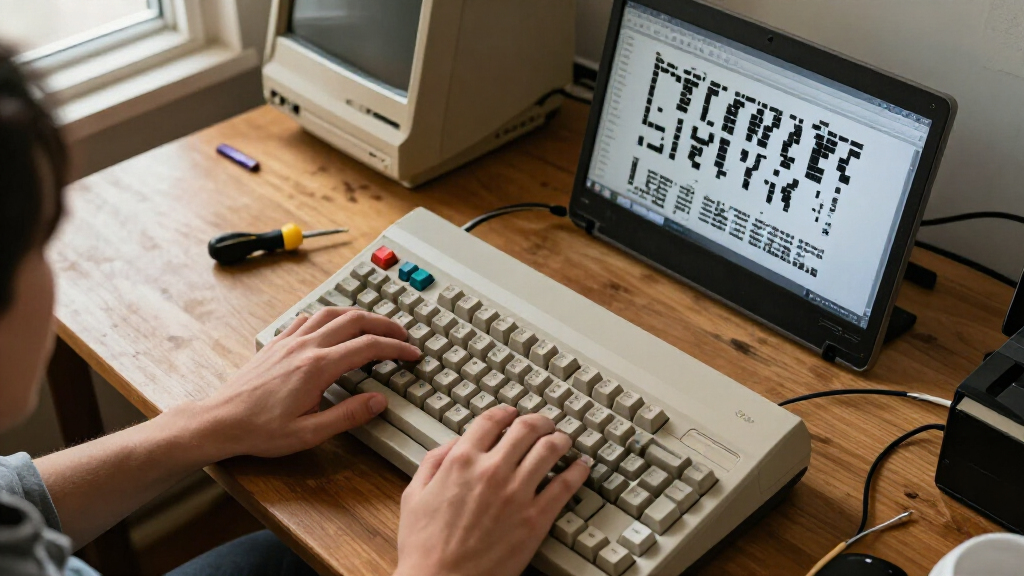
Levente Szabadkai has published C64 Keyboard, a font based on photographs of keycaps from his Central European Commodore 64. It recreates the printed legends, including 63 PETSCII graphics, and is available in several font formats under a CC0 dedication. The recreated graphics are not exact photo traces, and the project is unofficial.
Developer Levente Szabadkai has published C64 Keyboard, a font recreating the printed lettering and symbols on classic Commodore 64 keycaps from photographs of his own Central European keyboard. The font is available as TTF, OTF and webfont files, and includes 63 PETSCII graphic legends as well as letters, numbers and function-key labels.
The project’s GitHub page says the type shapes were cleaned up and adjusted for consistent proportions. The font includes uppercase letters, numbers, punctuation, arrows, the pound sign and pi, along with selected accented letters, including Hungarian characters. Lowercase input displays as uppercase, reflecting the key legends represented by the typeface.
The package also includes f1–f12 labels and the 63 graphics printed on the front of C64 keys. A browser-based preview lets users test the font and insert PETSCII symbols. The project says users can install either the TTF or OTF file, or download the complete package and open its preview page.
The PETSCII symbols are reconstructed outlines, not direct traces of the photograph. The project says symbol identities and key assignments draw on the Ultimate Commodore 64 Reference, while details such as curves, frame thickness and print proportions are inferred from the keyboard photograph. The font recreates the printed key legends; it is not the Commodore 64’s screen bitmap font.
A Keycap Reference Made Usable
The release turns a specific piece of Commodore 64 hardware design into a typeface that can be used in documents, graphics and web projects. Including both ordinary legends and the less familiar PETSCII symbols gives users a way to reproduce more of the keyboard’s visual character than a standard alphabet-only font would.
The project also makes the source work accessible in editable form: its repository includes glyph outlines, build tools and documentation. The author dedicates the contributions covered by the repository to the public domain under CC0 1.0, permitting use, modification and redistribution, including for commercial purposes. That dedication does not grant rights to historical keycap designs or trademarks held by others.
Popular right now

Vitamix 5200 Professional-Grade Blender, 64 oz. Container, Black

De'Longhi Rivelia Fully Automatic Espresso Machine with Milk Frother, White

eufy C28 Robot Vacuum Cleaner and Mop for Pet Hair, 15,000 Pa
As an affiliate, we earn on qualifying purchases.
Photographs, Legends and PETSCII
The font is based on photographs of keycaps from Szabadkai’s own Central European Commodore 64, which serve as the reference for the letters, numbers and symbols. The project describes its aim as recreating what was printed on the keyboard, rather than reproducing the pixel-based lettering displayed by the computer.
PETSCII graphics appear as front legends on the keys, with different symbols associated with Commodore and Shift combinations in uppercase/graphics mode. The project’s preview provides buttons to insert these symbols into a type tester, and its documentation points users to a key map and encoding guide. The special characters need the C64 Keyboard font to display as intended.
“The lettering comes from my own Commodore 64, a Central European unit.”
— Levente Szabadkai, project author, in the GitHub project description
Limits of the Reconstruction
The source material does not state when the font was first published, how many people have downloaded or used it, or whether further releases are planned. It also does not provide a measurement of how closely each letter or symbol matches the photographed keycaps. The author explicitly describes the PETSCII forms as reconstructed outlines whose proportions and details are inferred from the image.
The repository says the close-up photographs used for tracing are not included. Its CC0 dedication covers the author’s contributions, but it does not settle any rights that others may hold in the historical keyboard designs or Commodore trademarks. The project says it is unofficial and not endorsed by Commodore.
Download and Test the Font
Readers can try the typeface in the project’s online preview or download the TTF, OTF, webfont or complete package from GitHub. The package includes a local preview page; users can select function-key or PETSCII buttons to insert symbols into the tester, then copy the text into another application using the C64 Keyboard font.
The project’s instructions say users with an earlier version should replace it with version 1.112 and restart applications that still display the older font. The available source material does not identify a further release date or planned milestone.
Key Questions
What is the C64 Keyboard font?
It is an unofficial typeface by Levente Szabadkai that recreates printed legends on Commodore 64 keycaps using photographs of his own Central European keyboard.
Which symbols and characters are included?
The font includes uppercase letters, numbers, punctuation, arrows, £, π, selected accented characters, f1–f12 labels and all 63 PETSCII graphic front legends. Lowercase input appears as uppercase.
Does it reproduce the C64 screen font?
No. The project recreates the printed keycap legends, not the Commodore 64’s screen bitmap font.
Are the PETSCII designs exact copies of the photographs?
No. The project describes them as reconstructed outlines. Their identities and key assignments are referenced against the Ultimate Commodore 64 Reference, while visual details are inferred from the keyboard photograph.
Can the font be used commercially?
The author dedicates contributions in the repository to the public domain under CC0 1.0, allowing use, modification and redistribution, including commercially. The project cautions that this does not grant rights to historical keycap designs or trademarks held by others.
Source: hn