To choose studio lighting for your workflow, start by selecting lights with a high CRI (90+), ensuring accurate color rendering. Match the color temperature to your camera’s white balance, ideally around 5500K for natural daylight. Use diffusers like softboxes for gentle hues or modifiers to control light direction and color shifts. Pay attention to spectral quality for true-to-life colors, and adjust setups based on your desired aesthetic. Keep exploring to discover how these factors come together for perfect results.
Key Takeaways
- Match the light’s color temperature (~5500K) with your camera’s white balance for accurate color reproduction.
- Choose lighting with high spectral fidelity and CRI (90+) to ensure true-to-life color rendering.
- Use appropriate light modifiers (softboxes, diffusers) to control light quality and minimize color shifts.
- Align lighting setup with your desired color palette and aesthetic to streamline workflow and achieve consistent results.
- Regularly calibrate and adjust lighting to maintain stable color temperature and spectral quality throughout your shoot.
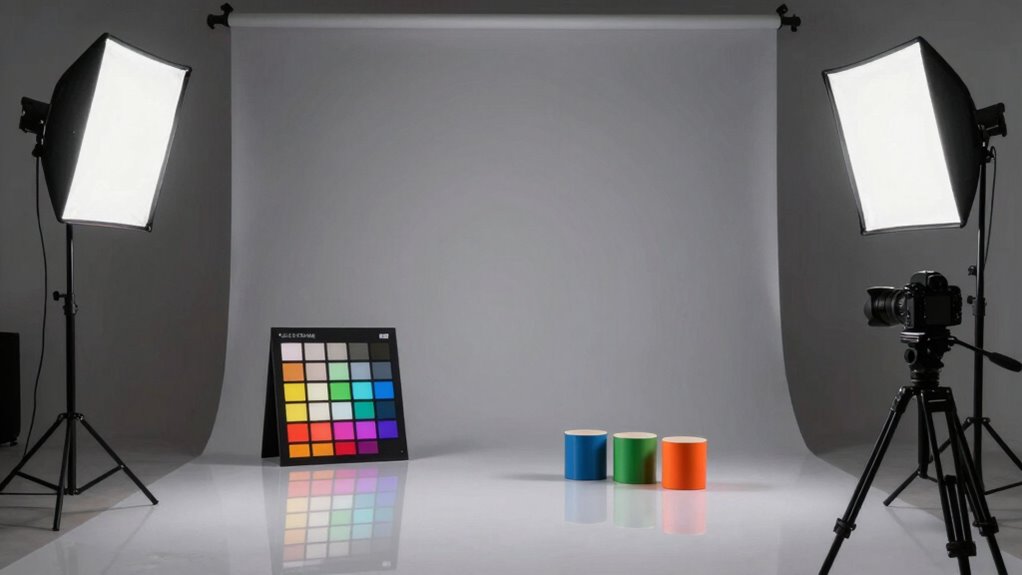
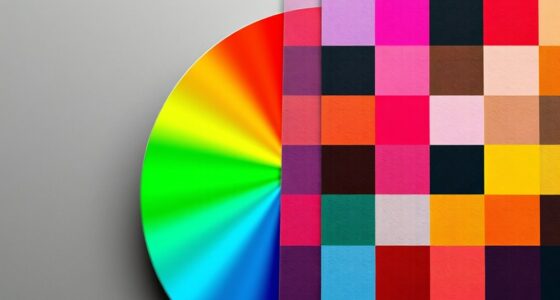
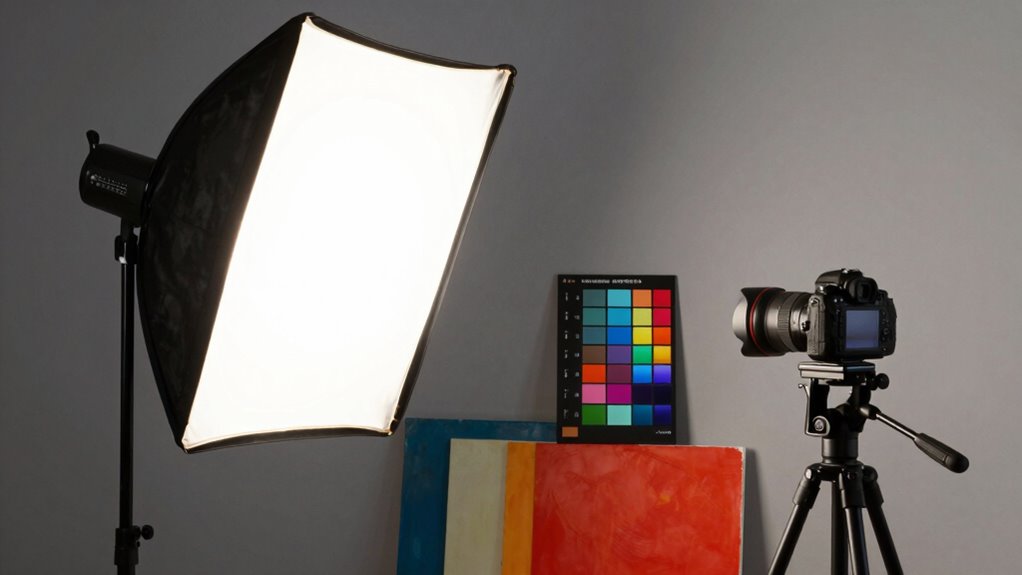
When selecting studio lighting for color photography, understanding how different light sources influence hue and saturation is essential. Your choice of lighting affects how colors appear on camera, impacting your overall workflow and the final image. One of the most critical factors is color temperature, measured in Kelvin, which determines whether your light produces a warm or cool tone. For accurate color reproduction, you want a light source with a stable and consistent color temperature, ideally around 5500K, which closely mimics natural daylight. This consistency ensures that your colors stay true and predictable, reducing the need for extensive post-processing. Additionally, the spectral quality of your light source influences how accurately colors are rendered, making color fidelity a crucial consideration in your setup. Light modifiers play a significant role in shaping your light source’s output, affecting both the quality and color rendering. Softboxes, umbrellas, and grids are common modifiers that can diffuse or direct light, impacting how colors are rendered. Diffused light from softboxes tends to produce softer, more even illumination, which helps preserve the integrity of subtle hues. Conversely, harsher light from direct modifiers can cause color shifts, especially if the light source isn’t well-balanced or if the modifier introduces color casts. When selecting light modifiers, consider how they influence the light’s spectral quality; high-quality modifiers will minimize color shifts and maintain color fidelity. Your workflow should align with your intended color palette and overall aesthetic. If you’re aiming for vibrant, saturated colors, you might prefer a lighting setup that enhances contrast and intensity, often achieved with slightly warmer or cooler light sources combined with specific modifiers. For more subdued, pastel tones, softer lighting with neutral color temperature and diffusers can help maintain gentle, accurate hues. It’s also essential to match your studio lights’ color temperature with your camera settings and post-processing workflow. Consistency between your light source and camera white balance ensures that colors remain stable from shot to shot, minimizing editing time. Additionally, consider the CRI (Color Rendering Index) of your lights. A high CRI (90 and above) indicates that the light source renders colors more accurately and vividly. When shooting for color-sensitive projects—such as product photography or fashion shoots—this becomes especially important. Combining the right color temperature with suitable light modifiers and high-CRI lights allows you to control the color environment precisely. This strategic approach simplifies your workflow, reduces post-production adjustments, and guarantees that your final images match your creative vision with clarity and true-to-life hues. Recognizing the importance of spectral quality helps you select lighting that faithfully reproduces colors across different hues and saturation levels.

NiceVeedi 36W Photography Lighting, Bi-Color Studio Light, CRI 95+, Dimmable AC Adapter Powered LED Video Light Kit with Remote Control & 72” Tripod, Light for Video Recording/YouTube/TikTok/Ins
【POWERFUL BI-COLOR PHOTOGRAPHY LIGHTING KIT】This 36W photo light is equipped with 360 high-quality beads and delivers 3000 Lumens…
As an affiliate, we earn on qualifying purchases.
As an affiliate, we earn on qualifying purchases.
Frequently Asked Questions
How Does Ambient Lighting Affect Studio Color Accuracy?
Ambient lighting greatly influences your studio color accuracy by affecting color perception and lighting mood. If ambient light is too warm or cool, it can distort colors, making them appear different than they truly are. To guarantee accurate color reproduction, you need to control ambient light, balancing it to complement your studio lighting. This way, you maintain consistent color perception and create the desired lighting mood without compromising your workflow.
What Is the Ideal Color Temperature for Studio Lighting?
The ideal color temperature for studio lighting is around 5,500K, balancing daylight’s clarity with warm tones. You want excellent color rendering to see true hues, while light diffusion guarantees soft, even illumination. Think of it as blending the crispness of natural light with gentle softness, giving your colors accuracy and consistency. This balance helps your workflow produce vibrant, true-to-life images, no matter the subject or setting.
How Can I Calibrate My Studio Lights for Consistent Color?
To guarantee color consistency, you need to perform proper light calibration. Start by using a color calibration tool, like a colorimeter or spectrometer, to measure your studio lights’ output. Adjust your lighting settings or use the calibration software to match a standard color profile. Regularly recalibrate your lights, especially after changing bulbs or adjusting your setup, to maintain accurate color reproduction and consistent workflow results.
Are LED Lights Better Than Fluorescent for Color Accuracy?
LED lights generally offer better color accuracy than fluorescent lights due to higher color rendering, meaning they display colors more naturally and vividly. They also produce less flicker and heat. Additionally, LEDs provide better light diffusion options, helping you achieve more even, consistent lighting suited for color-critical work. Overall, for precise color workflows, LEDs are a smarter choice because they deliver consistent, accurate color rendering with versatile diffusion capabilities.
How Do I Choose Lighting for Different Skin Tones?
To tailor lighting for diverse skin tones, focus on fine-tuning your setup for flattering, true-to-life results. Start with skin tone matching to guarantee colors appear natural, and use lighting modifiers like softboxes and reflectors to soften shadows and enhance warmth. You’ll want versatile lighting that can adapt to different hues, creating a balanced, beautiful glow. Consistent experimentation helps you master the art of flattering, accurate skin tone representation.

EMART Full Spectrum Light Bulb, 105W Spiral CFL 5500k Daylight for Softbox Lighting Kit, Replacement Lamp for Photography Photo Video Studio, Household Use, Portrait Shooting -2PACK
[2 Pack 105W CFL Daylight] Power:105W/500W (output equivalent), Style:Spiral, Color temperature: 5500K, Voltage: 110V-130V, Lifetime: >8000h, Lumen: 5800,…
As an affiliate, we earn on qualifying purchases.
As an affiliate, we earn on qualifying purchases.
Conclusion
Think of your studio lighting like a painter’s palette—you need the right colors to bring your vision to life. I once tried adjusting my lights for a photoshoot, only to realize I was mixing the wrong hues, resulting in dull images. Once I found the perfect balance, everything clicked. Remember, choosing the right lighting isn’t just technical—it’s about crafting the mood and tone you envision. Get it just right, and your work will shine brightly.

Altura Photo Flash Diffuser Light Softbox 6×5 (Universal, Collapsible with Storage Pouch) for Canon, Yongnuo and Nikon Speedlight
Altura Photo Softbox Flash Diffuser for Shoe Mount Flash Units.
As an affiliate, we earn on qualifying purchases.
As an affiliate, we earn on qualifying purchases.
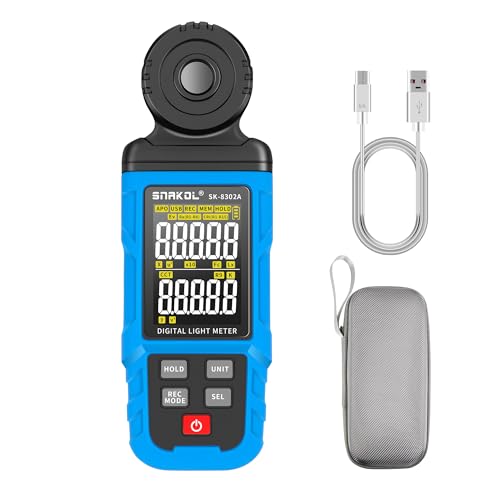
SNAKOL Spectral Illuminance Meter SK-8302A Light Meter, Lux Meter, CCT,RA,CRI,R9,Range up to 200,000 Lux 2500K-15000K, Color Coordinate,Data Storage, USB Charger, PC Software,Lighting Testing Tool
Main Functions:illuminance 0 – 200,000 lux, CCT 2500K – 15000K,RA 400nm-700nm,CRI,R9,color coordinates.
As an affiliate, we earn on qualifying purchases.
As an affiliate, we earn on qualifying purchases.