
TL;DR

Get art and craft supplies delivered free with Prime
- Fast, free delivery on millions of items
- Prime Video, Amazon Music and more included
- Member-only deals all year
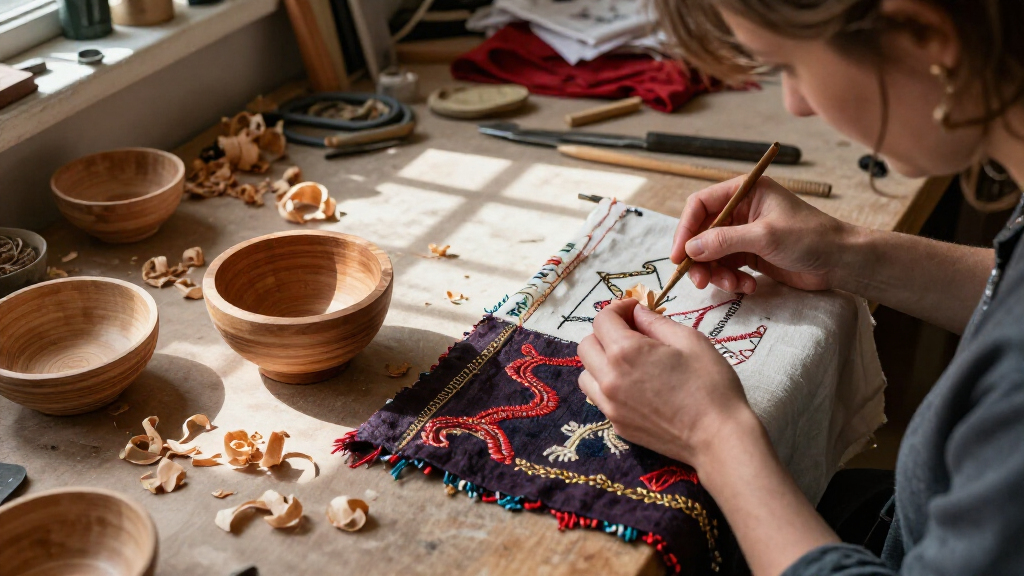
Furniture maker and artist Aspen Golann has created carved wooden vessels and a five-foot-four cabinet that translate motifs from 17th-century embroidery into wood. The Crewel Cabinet will appear in a New York group exhibition opening November 6, while Golann is also developing a U.S. Treasury commission and a solo exhibition planned for next November.
Furniture maker and artist Aspen Golann has translated motifs from early American embroidery into carved wooden vessels and a cabinet, bringing a historically under-researched craft into larger sculptural forms. Her five-foot-four-inch Crewel Cabinet, made during an 18-month artisan residency, is scheduled to appear in the group exhibition Pattern Recognition: Superhouse at Five in New York from November 6 through December 19.
The cabinet is built from 37 narrow wooden staves joined edge to edge to make a rounded form. Each stave contains 14 colored layers; Golann carved plants, rabbits, dogs and other imagery through those layers, using the shifting colors to evoke the threads and patterns of colonial-era crewel embroidery. The work stands five feet, four inches tall, approximately the average height of an American woman, according to the source report.
Golann’s embroidery-inspired work also includes a series of wooden vessels. The “Pouring Vessel” carries needlework motifs interpreted through a strapworking technique. The “Strap-Carved Vessel” is compressed into a flat, unusual silhouette, but remains hollow. The artist’s work was developed as part of the Metropolitan Museum of Art and Vacheron Constantin Artisan Residency, an 18-month program focused on preserving and reinterpreting traditional craft techniques. Ceramicist Ibrahim Said and jeweler Joy Harvey also participated in the residency.
The exhibition is one of several planned presentations of Golann’s work. She is developing a furniture commission for the U.S. Treasury and working toward a solo exhibition at Fuller Craft Museum, slated to open next November. The Treasury piece is expected to use tones of precious metals in a paint-by-numbers arrangement to form an abstract landscape inspired by early American embroidery, with reflective surfaces intended to mirror viewers.
Giving Needlework a Larger Form
Golann’s project connects woodworking and needlework, two practices that carry different histories of visibility and recognition. The source report describes the embroidery made by young girls in colonial-era America as under-researched and under-displayed in major art institutions. Recasting its imagery in substantial furniture and vessels offers a way to draw attention to both the patterns and the makers who produced them.
The work also puts questions of function and decoration in direct view. Vessels can serve a practical purpose while also being displayed as art; Golann’s hollow, flattened vessel keeps the basic form of a container while emphasizing its carved surface. The cabinet scales up designs associated with small, portable textile objects into a piece of furniture that occupies a room. That change of scale is part of the artist’s stated effort to make an object that cannot simply be put away.
Popular right now

Vitamix 5200 Professional-Grade Blender, 64 oz. Container, Black

Shark Clean & Empty Cordless Stick Vacuum with Auto-Empty System, BU3521

Dyson Airwrap i.d. Multi-Styler for Straight and Wavy Hair
As an affiliate, we earn on qualifying purchases.
From Colonial Furniture to Embroidery
Golann’s interest in early American furniture began with the forms developed by colonists drawing on English motifs and techniques in the second half of the 17th century. Her contemporary chairs and benches include Meeting Bench, made with chairmaker Peter Galbert, and Union Settee. The source report says the works refer to a Boston interpretation of the high-backed Windsor chair and explore furniture’s role in bringing people together.
That research led Golann to early needlework, which the report says was pursued almost exclusively by women. She describes the embroidered compositions not only as products of restrictive expectations, including their role as dowry objects, but also as evidence of the makers’ creative expression and inner lives. The cabinet and vessels adapt those motifs rather than reproducing the original textiles.
““[The embroidery] is under-researched and under-displayed, and it’s fragile, rare, and stowable. I wanted to make some version of this thing that couldn’t be put away.””
— Aspen Golann, as quoted by Colossal
Details Still to Be Confirmed
The source report does not provide a full checklist for the New York exhibition, so it is not clear whether the Crewel Cabinet will be the only Golann work shown or whether the vessels will also be included. It also does not specify the Treasury commission’s final design, materials beyond the described precious-metal tones and reflective surfaces, or installation date. The report says Golann’s Fuller Craft Museum solo exhibition is slated for next November but does not give an exact opening day or title.
The account presents Golann’s historical interpretation and the residency’s aims, but does not cite independent curatorial or scholarly assessments of the works. Further details about the historical embroidery sources and the specific examples that informed each carved motif are not supplied.
Exhibition and Commissions Ahead
Pattern Recognition: Superhouse at Five is scheduled to open at Superhouse in New York on November 6, 2026, and run through December 19. Visitors and readers can look for the gallery’s exhibition information for any updates to the schedule or the final list of works.
Golann is also continuing work on the U.S. Treasury commission and preparing a solo exhibition at Fuller Craft Museum, which the source report says is slated for next November. No further milestones or completion dates are given for either project.
Key Questions
What is Aspen Golann showing in the New York exhibition?
The source report confirms that Crewel Cabinet will be included in Pattern Recognition: Superhouse at Five. It does not say whether her vessels or other works will also be shown.
When and where can the cabinet be seen?
The exhibition is scheduled at Superhouse in New York from November 6 through December 19, 2026.
How was Crewel Cabinet made?
Golann assembled 37 wooden staves, each built from 14 colored layers, into a rounded cabinet. She carved images including plants and animals through the layers to evoke the colors and motifs of crewel embroidery.
What is the connection to early American embroidery?
Golann researched colonial-era needlework, including embroidery made by young women, and adapted its imagery for carved wood. She has described the work as a way to draw attention to embroidery she considers under-researched and under-displayed.
What projects is Golann working on next?
She is developing a furniture commission for the U.S. Treasury inspired by early American embroidery and preparing a solo exhibition slated for next November at Fuller Craft Museum. The source report gives no exact dates for the commission or the museum show beyond that schedule.
Source: thisiscolossal.com