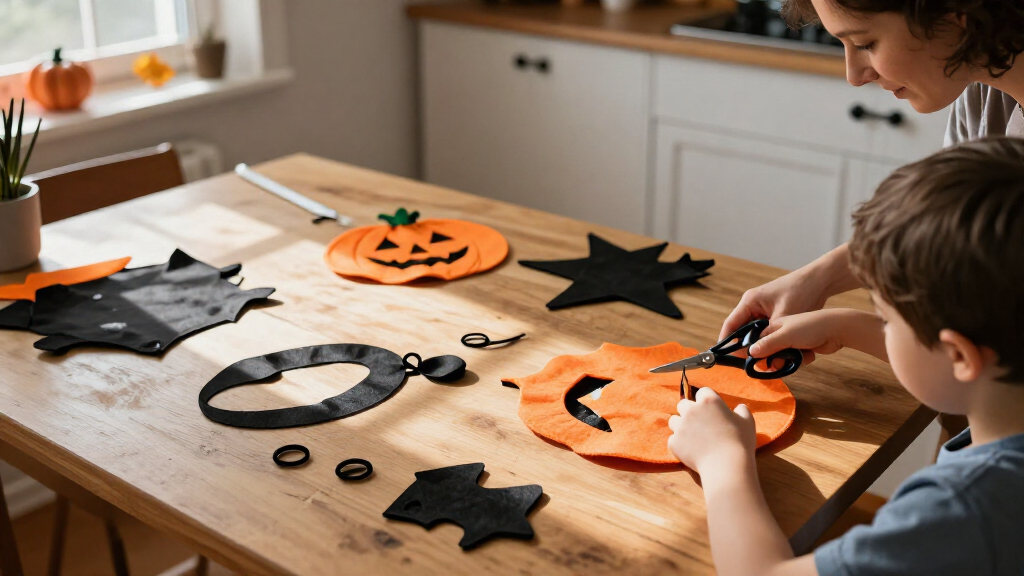
Make a DIY Halloween costume kit by choosing a costume idea, collecting its clothing and craft supplies, and packing them with simple instructions. This guide is for beginners preparing a kit for one person, a family, a classroom, or a small group. Allow about 1-2 hours to plan and assemble each kit, plus time to gather supplies.

Get art and craft supplies delivered free with Prime
- Fast, free delivery on millions of items
- Prime Video, Amazon Music and more included
- Member-only deals all year

Women’s Scarecrow Costume Accessory Set
- ✔ Material: 50% polyester, 30% plastic, 20% felt
- ✔ Age range: Adult
- ✔ Fit: Standard

Horolam Scarecrow Costume Accessories Kit for Adults, 7 Pieces
- ✔ Included items: Felt hat, neck straw piece, two wrist cuffs, two ankle cuffs, and drawstring
- ✔ Material: Felt and raffia
- ✔ Care instructions: Dry clean only

Adult Scarecrow Costume Kit with Felt Hat, Raffia, and Rope Belt
- ✔ Fabric: Felt
- ✔ Care: Hand wash only
- ✔ Closure: Snap
Difficulty: Beginner | Time: 1-2 hours, plus shopping time
What You’ll Need
Tools & Materials:
- Paper or a notes app for a materials list
- Measuring tape or clothing sizes
- Scissors
- Reusable bag, box, or tote for each kit
- Labels or masking tape and a marker
- Costume clothing and craft supplies
Knowledge:
- Basic cutting, tying, and simple craft assembly
- The wearer’s clothing size and comfort needs
- Basic age-appropriate craft and costume safety
Choose a costume that fits the wearer’s mobility, weather, and event rules. For children, plan for adult supervision with scissors, hot glue, small parts, makeup, or other craft materials. Use washable, skin-safe products and check any school or venue restrictions before buying supplies.
Women’s Scarecrow Costume Accessory Set
When we want a scarecrow costume to look coordinated without buying a full outfit, this is the most complete starting point in the group. Alongside the pointed hat and raffia pieces, it includes sunflower accessories, plaid patches, face stickers, and a DIY straw roll. That variety gives us more ways to establish the theme than Horolam’s seven-piece kit, which focuses on core accessories, or the Adult kit, which leaves more of the styling to our own choices.The lightweight pieces are designed to go over clothing we already own, so we can build the rest of the look with a shirt, trousers, and boots from our wardrobe. The adjustable waist rope and separate wrist and leg accessories also provide several points for arranging the look. That flexibility makes it useful for a Halloween party or a fall event, though the listed standard fit does not give the same specific circumference measurements Horolam supplies.We should think of this as a decorative accessory bundle, not an all-in-one costume. Clothing is not included, and although the straw roll and decorations invite some DIY styling, the supplied details do not explain how each decoration attaches. Care instructions are also not specified, so we have less guidance for cleaning than with either competing kit. Choose it for the widest set of coordinated details; skip it if we need a complete outfit or want clearly documented garment care.
Pros:
- Includes a hat, raffia accessories, patches, sunflowers, face stickers, and a DIY straw roll
- Lightweight pieces are designed to wear over personal clothing
- Multiple decorative elements allow some customization
- Suitable for Halloween parties and fall events
Cons:
- Shirt, trousers, boots, and other main clothing are not included
- Standard fit is less detailed than Horolam’s listed accessory measurements
- Care instructions are not specified
Best for: Adults who want the broadest range of scarecrow decorations to style over clothing they already own.
Not ideal for: Shoppers who need a complete costume with clothing, detailed fit measurements, or stated care instructions.
Bottom line: We recommend this as the most versatile base when we want the most included details for a DIY scarecrow look.
“We recommend this as the most versatile base when we want the most included details for a DIY scarecrow look.”
Horolam Scarecrow Costume Accessories Kit for Adults, 7 Pieces
Horolam suits us when fit details matter more than a large collection of decorative extras. The seven-piece kit covers the basics with a felt hat, neck straw piece, wrist and ankle cuffs, and a drawstring. Adjustable closures and listed circumferences make it easier to judge how the accessories may sit than with the Adult kit, whose sizing information is more limited. The measurements do not guarantee a fit for every wearer, but they give us something concrete to compare against.Compared with the Women’s set, Horolam is more restrained: it does not list sunflower decorations, patches, face stickers, or a DIY straw roll. That smaller accessory selection can make the costume simpler to assemble, especially for a school play or festival where a clear scarecrow silhouette is enough. We will still need to supply the outfit underneath, and the description does not include the extra decorative range that makes the Women’s set the stronger pick for a more embellished look.The main practical drawback is dry-clean-only care, which is less convenient for accessories worn over clothes at a Halloween event. One size is listed for most adults, but the stated hat, neck, wrist, and ankle circumferences are worth checking before choosing it. Pick Horolam for a defined accessory set with fit measurements; choose the Women’s kit if extra visual details matter more, or the Adult kit if we prefer a smaller, hand-washable bundle.
Pros:
- Seven core pieces cover the hat, neck, wrists, ankles, and waist
- Adjustable closures help tailor how accessories sit
- Lists circumferences for the hat, neck piece, cuffs, and drawstring
- Suitable for Halloween, plays, festivals, and stage productions
Cons:
- Dry clean only
- Does not include a shirt, jeans, or other costume clothing
- Offers fewer decorative customization pieces than the Women’s set
Best for: Adults who want a defined scarecrow accessory set and prefer checking listed measurements before buying.
Not ideal for: Buyers looking for extensive decorative extras or accessories that can be maintained without dry cleaning.
Bottom line: We’d choose Horolam when its fit measurements and focused accessory list are more useful than extra decoration.
“We’d choose Horolam when its fit measurements and focused accessory list are more useful than extra decoration.”
Adult Scarecrow Costume Kit with Felt Hat, Raffia, and Rope Belt
This kit keeps the ingredient list simple: a felt hat, raffia straw pieces, a bundle of raffia, and a rope belt. It is the most open-ended choice here. We can arrange the stretchable straw pieces on the neck, wrists, or legs and use our own clothing and styling to fill in the rest. Compared with Horolam, it provides fewer defined accessory types and no circumference details for cuffs; compared with the Women’s set, it omits the patches, sunflowers, and face stickers that make a look feel more coordinated straight out of the package.That simplicity may be welcome if we already have a specific scarecrow outfit in mind or want accessories that can be placed in different ways. The rope belt and raffia bundle give us room to adjust the styling, while the felt hat supplies a recognizable focal point. The description says the hat fits most and gives its circumference, but the rest of the fit guidance is limited to the stretchable straw pieces, so we have fewer specifics to check than with Horolam.Care is another tradeoff: the pieces are listed as hand-wash only. That is less demanding than Horolam’s dry-clean-only instruction, but still calls for care after wear. We also need to provide all main clothing and be comfortable supplying some of the visual finish ourselves. This is the best match for a low-fuss, adaptable foundation, while buyers who want a ready-coordinated set should look to the Women’s kit.
Pros:
- Includes a felt hat, raffia pieces, raffia bundle, and rope belt
- Stretchable raffia pieces can be worn on the neck, wrists, or legs
- Simple set leaves room for personal styling
- Suitable for parties, plays, harvest events, cosplay, and seasonal decor
Cons:
- Hand-wash only
- Sizing details beyond the hat circumference and stretch fit are limited
- Has fewer included decorative elements than the Women’s set
Best for: Adults who want a small, adaptable set of scarecrow accessories and plan to supply their own costume styling.
Not ideal for: Buyers who want many coordinated decorations or precise fit details for every accessory.
Bottom line: We’d pick this kit when adaptable raffia and a simple belt-and-hat base matter more than a fuller set of decorations.
“We’d pick this kit when adaptable raffia and a simple belt-and-hat base matter more than a fuller set of decorations.”
As an Amazon Associate we earn from qualifying purchases.
Before You Start
Decide whether each kit will make one full costume or provide shared supplies for a group. Confirm the number of wearers, sizes, budget, event date, and whether costumes need to work over warm layers. Choose a design that can be made with supplies you can readily obtain. Avoid relying on a particular brand, tool, or specialty item unless you have a backup.
Separate wearable items from craft materials while planning. Keep sharp tools, hot glue, and small parts out of kits intended for unsupervised young children. Build in time to try on the costume before Halloween so you can fix fit or comfort problems.
Step-by-Step Instructions
Step 1: Choose a simple costume theme
Pick one recognizable idea that suits the wearer and the event, such as a cat, a scarecrow, a robot, or a storybook character. Write down the main visual features that make it recognizable. Keep the design to a few pieces, such as clothing, one accessory, and optional face paint, so the kit stays manageable.
Tip: For a group, choose a shared theme but let each person personalize one color or accessory.
Check: You can describe the costume in one sentence and list its main pieces.
Step 2: Set the budget and check what you already own
Set a spending limit per costume, then check closets and craft supplies before shopping. Record usable base clothing, such as a black shirt, leggings, or a plain sweatshirt. Subtract these items from the shopping list and reserve part of the budget for replacement pieces or last-minute fixes.
Tip: Use washable everyday clothing as the base when possible; it is often more comfortable and useful after Halloween.
Check: Your list shows which items are already available and the remaining cost fits the budget.
Step 3: Make a complete materials list
List every item needed to wear and finish the costume: base clothing, accessories, decoration, fasteners, and any makeup. Add quantities for each wearer and note sizes, colors, or preferred alternatives. Include assembly supplies such as tape, elastic, fabric glue, or safety pins only when the design calls for them.
Tip: Mark tools that require adult handling so they do not get mistaken for child-ready kit contents.
Check: Someone who has not seen your plan could use the list to gather all costume parts.
Step 4: Check fit, comfort, and safety
Review each piece for fit, movement, visibility, and weather. Make sure hats and masks do not block sight or breathing, capes and long fabric do not drag near feet, and accessories have no sharp edges. Choose materials that will not irritate skin, and avoid loose small parts for young children.
Tip: Plan for a jacket or warm layer if the costume will be worn outdoors in cold weather.
Check: The design allows the wearer to walk, sit, see, and use the bathroom without removing difficult pieces.
Step 5: Gather and prepare the supplies
Buy or collect the listed items, then check each against the plan. Wash clothing if needed, trim loose threads, and test craft materials on a hidden area before applying them visibly. Cut decorative pieces to size only when you can do so safely; otherwise, include the measurements and have an adult handle cutting during assembly.
Tip: Keep receipts and packaging until you confirm that sizes and quantities are correct.
Check: All required parts are present, clean, and suitable for the intended wearer.
Step 6: Write concise assembly instructions
Write the build order as short actions, starting with putting on the base clothing and ending with accessories or makeup. Specify where decorations attach and which materials to use. Add simple alternatives for optional pieces and a safety note for any step involving scissors, heat, adhesives, or cosmetics.
Tip: Include a sketch or photo reference if the placement of a feature may be unclear.
Check: A helper can follow the instructions without guessing the order or location of the costume pieces.
Step 7: Pack and label the kit
Place the clothing, accessories, craft materials, instructions, and any small repair supplies into a bag or box. Put loose pieces in a sealed, labeled pouch so they do not disappear. Label the outside with the costume name and wearer’s size; for a group, label each kit with the person’s name or assigned number.
Tip: Do not pack scissors, hot glue guns, or other adult-use tools into a child’s kit unless an adult will supervise assembly.
Check: Each kit is identifiable, contains its listed contents, and keeps small parts together.
Step 8: Test the costume before the event
Have the wearer try on the costume with the intended layers and shoes. Follow the instructions to attach decorations, then check comfort, movement, visibility, and whether fasteners stay in place. Make small adjustments now, and return any unused or unsuitable items to the supply area.
Tip: Take a photo of the finished costume as a reference for reassembly on Halloween.
Check: The wearer can move comfortably, and the costume stays together during ordinary walking and sitting.
Common Mistakes to Avoid
- Choosing a design with too many specialty parts. — Limit the costume to a few defining features and use clothing or materials that are easy to find.
- Buying supplies before checking sizes or what is already available. — Check the wearer’s measurements and inventory household supplies before shopping.
- Packing small parts or tools without considering the wearer’s age. — Separate adult-use tools and small components, label them clearly, and supervise children during assembly.
- Waiting until Halloween to test the fit. — Schedule a full try-on after assembling the kit and leave time to make changes.
Troubleshooting
Problem: A key material is unavailable or out of stock.
Solution: Replace it with a similar color or texture that keeps the costume recognizable. Update the instructions so they match the substitute.
Problem: A decoration will not stay attached.
Solution: Use a fastener suited to the fabric, such as a safety pin or fabric tape, and test it on a hidden area first. Avoid applying heat or adhesive directly to delicate clothing.
Problem: The costume feels too warm, restrictive, or uncomfortable.
Solution: Remove a layer or bulky accessory, switch to breathable clothing, and repeat the movement check before the event.
Problem: A kit is missing a piece during assembly.
Solution: Compare the contents with the materials list. Use a listed alternative, or make a replacement from safe household material and revise the kit checklist.
What Success Looks Like
The finished kit contains every listed clothing and craft item, has clear assembly instructions, and is labeled for the correct wearer. After a try-on, the costume is recognizable, fits over planned layers, stays attached during movement, and allows the wearer to see, walk, sit, and breathe comfortably. Adult-only tools and small parts are identified and handled with suitable supervision.
Next Steps
Store each tested kit in a dry place with its instructions and repair supplies. On Halloween, check the costume again for secure fasteners, clear visibility, and suitable outer layers. After the event, clean reusable clothing and accessories according to their care labels, then keep useful pieces for future costumes.
Frequently Asked Questions
How far ahead should I assemble a DIY Halloween costume kit?
Start planning a few weeks before the event if you need to shop or order supplies. Assemble and test the costume several days ahead so there is time to replace a missing item or adjust the fit.
What should I put in a costume kit for a young child?
Include wearable clothing, soft accessories, simple decorations, and picture-based or short written instructions. Keep sharp tools, hot glue, and small parts with an adult, and supervise any assembly that uses them.
Can I make a kit without sewing?
Yes. Choose a design that uses existing clothes and removable attachments such as fabric tape, elastic, or safety pins. Test each attachment on the garment first and follow its care and use instructions.
How can I keep several kits organized?
Pack each costume separately, label it with the wearer’s name or size, and put small components in a labeled pouch inside the kit. Keep one master checklist to track shared supplies and missing items.