
TL;DR

Get art and craft supplies delivered free — and shop member deals
- Fast, free delivery on millions of items
- Access to Prime Big Deal Days deals on October 6–7
- Prime Video, Amazon Music and more included
New Mexico-based artist Max Lehman’s exhibition Ancestral Androids is on view at Hecho a Mano in Santa Fe through November 1, 2026. Its ceramic sculptures combine references to Pre-Columbian visual culture with science-fiction-inspired ideas about artificial beings, memory and what future archaeologists might understand from surviving objects.
New Mexico-based artist Max Lehman is presenting Ancestral Androids, an exhibition of ceramic sculptures imagining a future in which artificial beings leave ruins for archaeologists to interpret. The show, at Hecho a Mano in Santa Fe through November 1, combines science-fiction ideas with visual references to Pre-Columbian art and raises questions about how objects acquire meaning when their origins are lost.
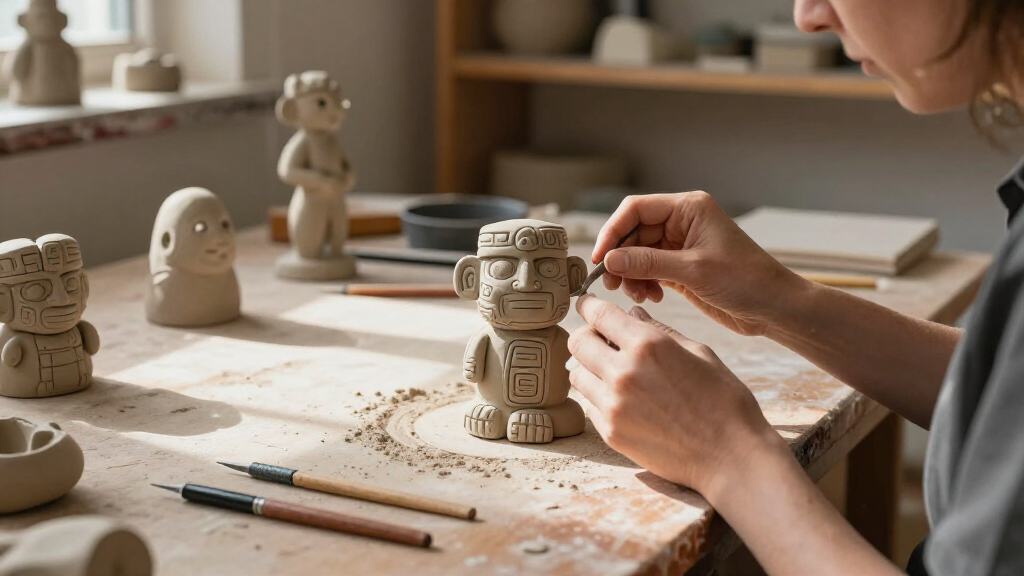
Lehman’s sculptures are made from ceramic, with acrylic and metallic paint on several pieces; some are glazed ceramic. The works include brightly colored, humanlike or machine-like figures with titles such as “The Malachite Mage,” “The Sapphire Sage” and “The Duchess of Digital Data.” Colossal’s report describes their expressions as cartoonish and at times unsettling, with additional faces appearing on some figures’ foreheads or bellies.
The artist’s imagined future is presented through objects that might be mistaken for evidence of a past civilization. Colossal reports that Lehman pictures his sculptures being excavated long after their origin and purpose have been forgotten. The works do not come with definitive accounts of the fictional beings they depict; instead, their titles and forms leave room for competing interpretations.
Among the listed works are “Petro who is Predicting the Unpredictable” (2026), a ceramic sculpture with acrylic and metallic paint, and “Mayan Max and His Pre-Colo iPad” (2026), made from glazed ceramic. The exhibition also includes “The Hope for Environmental Renewal” and “Fiery Phineas and His Tablet of Doom,” both dated 2026. Colossal identifies Hecho a Mano as the exhibition venue and gives November 1 as its closing date.
Imagining Archaeology’s Future Evidence
The exhibition uses archaeological uncertainty as more than a reference to ancient history: it applies that uncertainty to present-day technology. Lehman’s invented artifacts ask viewers to imagine how future researchers might interpret devices and artificial beings after the contexts that explain them have disappeared. That premise connects the sculptures to current questions about digital archives, artificial intelligence and cultural memory.
The work also points to the limits of what can be inferred from an object alone. A sculpture may preserve traces of how it was made, while leaving its maker’s beliefs, intended use or social setting unresolved. Lehman’s focus on handmade clay forms sets physical material against a future shaped by machines and data, without claiming that the objects answer those larger questions.
As an affiliate, we earn on qualifying purchases.
Ancient Forms, Imagined Machine Ancestors
Lehman studies Pre-Columbian art history, according to Colossal. The report connects his work with visual traditions that include Maya carved stone slabs and the Mexica Sun Stone, also known as the Aztec calendar stone. These references provide historical points of comparison, but the sculptures in Ancestral Androids are contemporary works rather than archaeological objects.
The exhibition’s premise reverses the usual direction of archaeological speculation. Instead of asking only how people today interpret artifacts from the distant past, Lehman imagines future archaeologists examining present-day or fictional machine cultures. The resulting figures blend elements of ancient visual culture and science fiction; the report does not present them as reconstructions of specific historical deities or objects.
“I resist providing complete explanations because archaeology rarely offers certainty.”
— Max Lehman, in a statement quoted by Colossal
As an affiliate, we earn on qualifying purchases.
Details Beyond the Exhibition Listing
The source report identifies the venue, the exhibition title and its scheduled closing date, but does not provide gallery hours, admission details or information about sales. It also does not establish whether the exhibition will travel to another venue or whether Lehman plans related events. The figures’ narratives are presented as artistic speculation, not as claims about actual ancient or future civilizations.
Pre-Columbian inspired ceramic figures
As an affiliate, we earn on qualifying purchases.
As an affiliate, we earn on qualifying purchases.
Santa Fe Show Closes November 1
Ancestral Androids is scheduled to remain at Hecho a Mano through November 1, 2026. Visitors seeking practical details can check with the gallery; the source report does not list hours or admission information. Colossal also directs readers to Lehman’s Instagram for more of his work. No further exhibition dates or projects are specified in the report.
science fiction themed ceramic art
As an affiliate, we earn on qualifying purchases.
As an affiliate, we earn on qualifying purchases.
Key Questions
Where can visitors see Ancestral Androids?
The exhibition is at Hecho a Mano in Santa Fe, according to Colossal.
How long is the exhibition scheduled to run?
The report lists November 1, 2026 as the closing date.
What are Lehman’s sculptures made from?
The works use ceramic; several are described as having acrylic and metallic paint, while others are glazed ceramic.
Are the sculptures archaeological artifacts?
No. They are contemporary artworks by Max Lehman, informed by Pre-Columbian visual culture and science-fiction ideas about future archaeology.
What is the exhibition about?
Ancestral Androids imagines artificial beings leaving objects and ruins that future people might interpret as evidence of an earlier civilization. The sculptures explore memory, technology and the uncertainty of archaeological interpretation.
Source: rss
Halloween Picks
halloween
As an affiliate, we earn on qualifying purchases.