
TL;DR

Get art and craft supplies delivered free with Prime
- Fast, free delivery on millions of items
- Prime Video, Amazon Music and more included
- Member-only deals all year
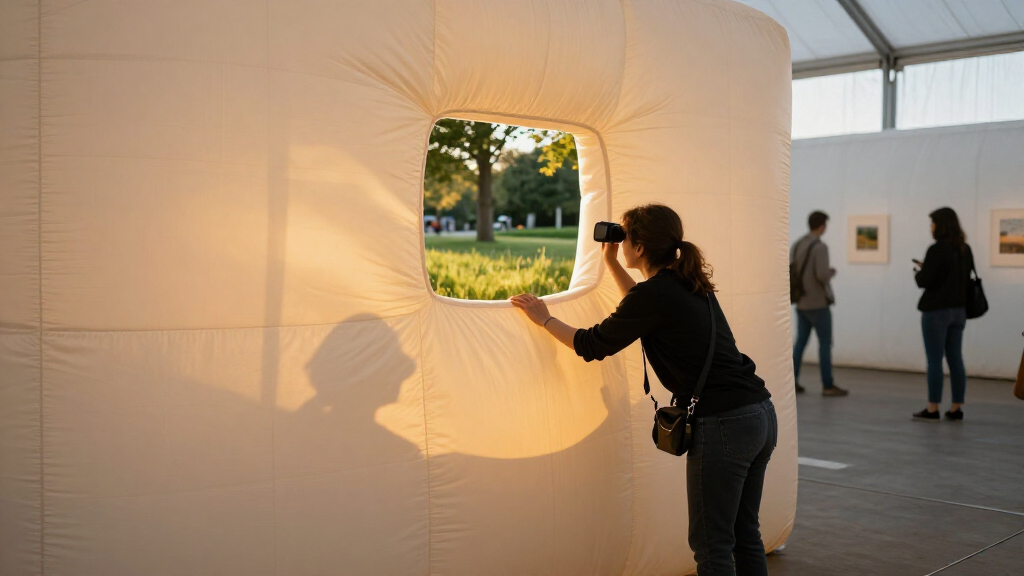
Pneuhaus’ Compound Camera 3 debuted late last month at MODE Festival as a walk-in installation made from an inflatable structure with 221 camera obscuras. Sunlight projects views of the sky and nearby surroundings inside; the source report says the work does not record images.
Rhode Island-based studio Pneuhaus premiered Compound Camera 3 late last month at MODE Festival, a photography event, presenting a walk-in inflatable installation built around 221 camera obscuras. Covering more than 700 square feet, the work uses sunlight to project views of the sky and surrounding urban environment onto its interior surfaces; according to the report, it does not record images.
The installation’s white, elongated form has been compared in the source report to an igloo or a large snail. Inside, visitors encounter a luminous viewing space formed by bulbous, soft surfaces. Small apertures around the structure act as camera obscuras, bringing images of the exterior into the room through an analog optical process rather than LED displays. The projections are powered by natural sunlight.
Lenses aimed upward show sections of the sky across multiple interior facets, while those pointed sideways bring in trees, buildings and passersby. The resulting views are fragmented and repeated. Visitors can press the soft interior material, changing the surfaces and distorting the projected image. The source describes the experience as a “bug’s-eye view” of the sky and urban surroundings.
The installation occupies more than 700 square feet, according to the report by Colossal. Photographs accompanying that report are credited to Lachlan Turczan and Stefan Stefanizyn. Pneuhaus is identified as a Rhode Island-based studio known for large-scale architectural inflatables.
A Camera Built for Looking, Not Recording
The work’s many lenses invite comparison with the cameras that now appear throughout public and private spaces, including doorbell cameras and license-plate readers. But the source report draws a clear distinction: Compound Camera 3 does not record or store images. It redirects light into a shared viewing environment, rather than collecting footage for a data system.
That difference makes the installation relevant to conversations about surveillance without making it a surveillance device, based on the information provided. Its images are temporary, dependent on available sunlight and the position of the surrounding scene. Visitors can alter the projection by pressing the material, making the act of viewing physical and changeable. The piece offers a way to examine familiar surroundings—sky, buildings and other people—through an unusual optical arrangement, rather than presenting a digital feed.
For audiences, the central distinction is between seeing and capturing. The structure contains many apertures, but the report says its purpose is an in-person experience, not persistent observation. How visitors interpret that contrast is open to them; the source does not report audience research or a formal statement from Pneuhaus about surveillance.
As an affiliate, we earn on qualifying purchases.
Pneuhaus and the Camera Obscura
A camera obscura forms an image when light passes through a small opening into a darker space. The image is produced optically, without requiring a digital sensor or screen. Compound Camera 3 expands that basic arrangement across 221 apertures and a large inflatable interior, so multiple views of the exterior appear at once.
The project is the latest work by Pneuhaus, which the source identifies as a studio specializing in large-scale architectural inflatables. It premiered at MODE Festival, described in the report as a celebration of global photography, late last month. The source does not provide specific dates for the festival or further details about the installation’s earlier development.
Colossal’s report frames the work alongside public concerns about networked cameras, while emphasizing that this installation is analog and does not record. That framing is useful context, but it is distinct from a direct quotation or detailed artist statement: the supplied source does not include an extended comment from the studio explaining its intentions.
““bug’s-eye view””
— Colossal’s report describing Pneuhaus’ installation
As an affiliate, we earn on qualifying purchases.
Exhibition Dates and Future Plans
The supplied report does not specify the festival’s exact dates, how long Compound Camera 3 will remain on view, or whether it will travel to other venues. It also does not give technical details about the lenses, the materials used, or how the installation performs under different lighting and weather conditions.
The report says no images are recorded, but it does not provide a technical explanation of the installation’s components or describe whether any separate documentation is made by the venue. It includes no direct, extended statement from Pneuhaus about the work’s relationship to surveillance or the studio’s intended interpretation. Those points should not be inferred beyond the source’s description.
As an affiliate, we earn on qualifying purchases.
Further Exhibition Information Awaited
The immediate next step for readers interested in seeing the work is to check for current exhibition information from MODE Festival or Pneuhaus. The source report points readers to Pneuhaus’ Instagram for more material, but it does not announce a future venue or exhibition schedule.
Any later reporting can clarify whether the installation will be shown again, how visitors can access it, and whether the studio will share additional technical or project details. Until those details are published, its future exhibition plans remain unconfirmed.
As an affiliate, we earn on qualifying purchases.
Key Questions
What is Compound Camera 3?
It is a walk-in inflatable installation by Pneuhaus that uses multiple camera obscuras to project views of the surrounding environment inside.
How many lenses does the installation have?
The source report says it has 221 lenses, each forming part of the installation’s image-capturing optical arrangement.
Does Compound Camera 3 record images?
The report says nothing is recorded. It describes the work as an analog viewing experience in which sunlight projects exterior scenes into the interior.
Where did the installation premiere?
It premiered late last month at MODE Festival, which the source describes as a celebration of global photography.
Can visitors change the projections?
Yes. The report says visitors can press the soft interior material, distorting the projected views on its surfaces.
Source: rss
Fall Picks
fall essentials
As an affiliate, we earn on qualifying purchases.