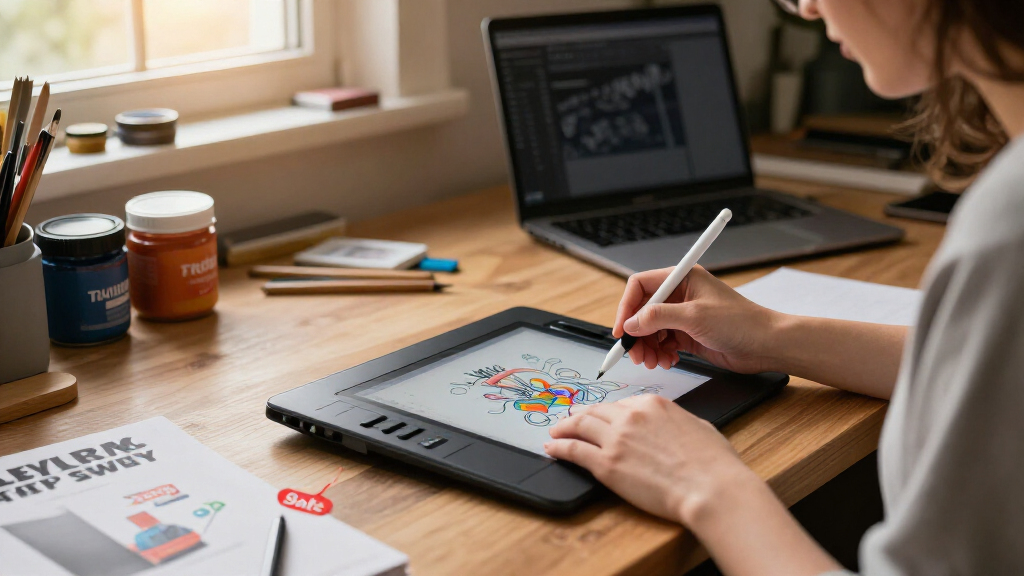

For Black Friday drawing tablets, my best overall pick is the HUION Kamvas 13 (Gen 3), which pairs a drawing screen with workflow controls without requiring a standalone tablet’s full setup. The Wacom Intuos Medium Bluetooth is a strong alternative for artists who already have a computer and want a simple, screen-free workspace, while the Frunsi RubensTab T14 suits people who want to draw on a larger standalone display. The main tradeoff is choosing between a connected pen tablet, a screen-based tablet that relies on a computer, and a self-contained model. Screen size, portability, software needs, and stylus feel matter more than a seasonal deal label. Read on for the full breakdown and help matching a tablet to your drawing habits.

Get art and craft supplies delivered free with Prime
- Fast, free delivery on millions of items
- Prime Video, Amazon Music and more included
- Member-only deals all year
Key Takeaways
- The lineup splits into three workflows: screen-free tablets such as the Wacom Intuos and HUION Inspiroy need a computer, Kamvas models add a computer-connected display, and Frunsi RubensTab, PicassoTab, and Kamvas Slate models are standalone.
- The HUION Kamvas 13 (Gen 3) models stand out for connected-screen drawing: the Gen 3 option with dual dial prioritizes on-tablet controls, while the other Gen 3 listing may suit buyers who want the same general screen-first approach without that named control feature.
- Standalone convenience comes with a size tradeoff: the 8-inch Frunsi T8 models are easier to carry, while the 14.1-inch RubensTab T14 gives more room to work but takes up more space.
- Screen-free tablets can be the practical value choice: the Wacom Intuos Medium, HUION Inspiroy H1060P, UGEE M708 V3, and GAOMON M10K avoid the extra display, but require drawing while looking at a separate monitor.
- Not every product here is built for finished artwork: the Kinayue 16-Inch LCD writing tablet is aimed at simple writing and doodling, so it should not be treated as a substitute for a graphics tablet with drawing software.
| Wacom Intuos Medium Bluetooth Drawing Tablet with Battery-Free Pen |  | Best for Wireless Desk Drawing | Tablet size: Medium | Connectivity: Bluetooth and USB-A | Pen: Pressure-sensitive, battery-free Wacom Pen 4K | VIEW LATEST PRICE | See Our Full Breakdown |
| HUION Kamvas 13 (Gen 3) Pen Display Drawing Tablet |  | Best for Color-Critical Screen Drawing | Display: 13.3-inch, full-laminated anti-glare Canvas Glass 2.0 with nano-etching | Pen pressure: 16,384 levels | Initial activation force: 2 g | VIEW LATEST PRICE | See Our Full Breakdown |
| Frunsi RubensTab T8 8-Inch Standalone Drawing Tablet |  | Best Entry-Level Standalone Pick | Screen: 8 inches | Resolution: 1200 × 800 | Operating system: Android 13 | VIEW LATEST PRICE | See Our Full Breakdown |
| HUION Kamvas Slate 11 Standalone Drawing Tablet, 10.95-Inch |  | Best Standalone All-Rounder | Operating system: Android 14 | Display: 10.95 inches, 1920 × 1200 FHD+ | Refresh rate: 90Hz | VIEW LATEST PRICE | See Our Full Breakdown |
| Kinayue 16-Inch LCD Writing Tablet for Kids |  | Best for Kids’ Screen-Free Doodling | Screen size and type: 16-inch LCD | Material: Flexible LCD screen and impact-resistant ABS shell | Stylus: Pressure-sensitive tethered stylus | VIEW LATEST PRICE | See Our Full Breakdown |
| Frunsi T8 Standalone Drawing Tablet with 8-Inch Display and Stylus |  | Best Compact Standalone Pick | Operating system: Android 13 | Display: 8 inches, 1200 × 800 | Processor: MTK octa-core | VIEW LATEST PRICE | See Our Full Breakdown |
| HUION Inspiroy H1060P Graphics Drawing Tablet with Battery-Free Stylus |  | Best Shortcut-Rich Screenless Tablet | Working area: 10 × 6.25 inches | Stylus: PW100 battery-free | Pressure levels: 8192 | VIEW LATEST PRICE | See Our Full Breakdown |
| UGEE M708 V3 Drawing Tablet, 10 x 6 Inch |  | Best Value Screenless Drawing Area | Active drawing area: 10 × 6 inches | Stylus: Passive | Pressure sensitivity: 16,384 levels | VIEW LATEST PRICE | See Our Full Breakdown |
| Frunsi RubensTab T14 Standalone Drawing Tablet with 14.1-Inch FHD Display |  | Best Large Standalone Display | Display: 14.1-inch Full HD IPS | Resolution: 1920 × 1200 | Processor: Octa-core CPU | VIEW LATEST PRICE | See Our Full Breakdown |
| HUION Kamvas 13 (Gen 3) 13.3-Inch Drawing Tablet with Screen and Dual Dial |  | Best Premium Connected Pen Display | Display: 13.3-inch fully laminated Canvas Glass 2.0 | Pressure sensitivity: 16,384 levels | Initial activation force: 2 g | VIEW LATEST PRICE | See Our Full Breakdown |
| Wacom Intuos CTL4100WLK0 Wireless Graphics Drawing Tablet, Black (Renewed) |  | Best Compact Drawing Tablet | Condition: Renewed | Connectivity: Bluetooth and USB | Pressure sensitivity: 4096 levels | VIEW LATEST PRICE | See Our Full Breakdown |
| GAOMON M10K Drawing Tablet with Touch Ring and 10 Shortcut Keys |  | Best Value for a Large Work Area | Active area: 10 × 6.25 inches | Stylus: AP31 battery-free stylus | Pressure sensitivity: 8192 levels | VIEW LATEST PRICE | See Our Full Breakdown |
| Frunsi RubensTab T11 Pro Standalone Drawing Tablet |  | Best Standalone Pick for Short Sessions | Display: 10.1-inch Full HD IPS | Resolution: 1920 × 1200 pixels | Processor: Octa-core CPU | VIEW LATEST PRICE | See Our Full Breakdown |
| PicassoTab A10 10-Inch Standalone Drawing Tablet |  | Best for Beginners Starting on a Screen | Display: 10-inch laminated LCD | Native resolution: 2000 × 1200 | Operating system: Android 14 | VIEW LATEST PRICE | See Our Full Breakdown |
| HUION Kamvas Pro 16 Drawing Tablet with Screen, 15.6-Inch, 120% sRGB |  | Best Premium Computer-Connected Display | Screen size: 15.6 inches | Color gamut: 120% sRGB; 92% AdobeRGB | Color depth: 16.7 million colors (8-bit) | VIEW LATEST PRICE | See Our Full Breakdown |
| Black Friday drawing tablet | Connectivity | Display |
|---|---|---|
| Wacom Intuos Medium Bluetooth | Bluetooth and USB-A | — |
| HUION Kamvas 13 | Dual-interface design; supports full-featured USB-C to USB-C | 13.3-inch, full-laminated anti-glare Canvas Glass 2.0 with nano-etching |
| Frunsi RubensTab T8 8-Inch Sta | — | — |
| HUION Kamvas Slate 11 Standalo | — | 10.95 inches, 1920 × 1200 FHD+ |
| Kinayue 16-Inch LCD Writing Ta | — | — |
| Frunsi T8 Standalone Drawing T | — | 8 inches, 1200 × 800 |
| HUION Inspiroy H1060P Graphics | — | — |
| UGEE M708 V3 Drawing Tablet | USB to USB-C; adapters included | — |
| Frunsi RubensTab T14 Standalon | Wi-Fi and USB-C charging | 14.1-inch Full HD IPS |
| HUION Kamvas 13 | 3-in-1 cable or full-featured USB-C | 13.3-inch fully laminated Canvas Glass 2.0 |
| Wacom Intuos CTL4100WLK0 Wirel | Bluetooth and USB | — |
| GAOMON M10K Drawing Tablet wit | USB | — |
| Frunsi RubensTab T11 Pro Stand | Wi-Fi and USB-C charging | 10.1-inch Full HD IPS |
| PicassoTab A10 10-Inch Standal | — | 10-inch laminated LCD |
| HUION Kamvas Pro 16 Drawing Ta | — | Fully laminated with anti-glare glass |
More Details on Our Top Picks
Wacom Intuos Medium Bluetooth Drawing Tablet with Battery-Free Pen
For Black Friday shoppers who want a dependable drawing surface without paying for a built-in display, the Wacom Intuos Medium is the most balanced pick in this group. Its battery-free, pressure-sensitive pen and four ExpressKeys cover the essentials for drawing, photo editing, and study, while Bluetooth lets you work without keeping a cable across your desk. Unlike the HUION Kamvas 13 (Gen 3), it has no screen to draw on, so your hand works on the tablet while you watch the computer monitor; that takes adjustment but also makes this a lighter, simpler setup. The Intuos connects by USB-A too, though newer devices may need an adapter. I’d choose it over a standalone model like the HUION Kamvas Slate 11 when desktop software and a larger monitor matter more than portability. Its medium surface still occupies desk space, and Android support is limited to select devices.
Pros:- Battery-free pressure-sensitive pen avoids charging interruptions.
- Bluetooth and USB-A offer wireless and wired connection options.
- Four ExpressKeys provide quick access to common commands.
- Includes replacement nibs and access to creative software and online training.
Cons:- No built-in display, so drawing requires looking at a separate screen.
- USB-A cable may need an adapter with newer computers.
- Android compatibility is limited to select phones and tablets.
Best for: Computer-based beginners and hobby artists who want wireless input, a pressure-sensitive pen, and shortcut keys without adding a pen display.
Not ideal for: Artists who need to see their strokes directly under the pen, or buyers who want a standalone tablet or broad Android compatibility.
- Tablet size:Medium
- Connectivity:Bluetooth and USB-A
- Pen:Pressure-sensitive, battery-free Wacom Pen 4K
- Shortcut keys:4 ExpressKeys
- Compatibility:Mac, Windows, Chromebook, and select Android devices
- Included accessories:USB-A cable, 3 extra standard nibs, and nib removal tool
- Warranty:1 year
Our verdict“Choose the Intuos Medium for wireless, computer-based drawing with a capable pen; pick the HUION Kamvas 13 (Gen 3) if drawing directly on a display matters more.”
HUION Kamvas 13 (Gen 3) Pen Display Drawing Tablet
The HUION Kamvas 13 (Gen 3) is the standout here for artists who want to draw on a display and care about color control. Its 13.3-inch laminated, anti-glare screen reduces the gap between pen tip and cursor, while the stated ΔE below 1.5 and broad color coverage suit illustration and image work where color choices matter. Two dials and five keys give it more hands-on workflow control than the screenless Wacom Intuos Medium; in return, the Kamvas needs a connected computer or compatible device and is not a standalone tablet. Its 16,384 pressure levels and low 2 g activation force support delicate line starts, but those specifications won’t remove the need to learn the drawing software. Compared with the standalone HUION Kamvas Slate 11, this is the better fit for a computer-centered desk setup, not for sketching independently on the go. Check device compatibility before choosing USB-C or Android use.
Pros:- Full-laminated, nano-etched anti-glare surface reduces glare and screen-to-pen separation.
- Factory-calibrated display lists ΔE below 1.5 and broad color coverage.
- Pen supports 16,384 pressure levels and a stated 2 g initial activation force.
- Two dials and five shortcut keys support customizable workflows.
Cons:- Must connect to a computer or compatible device; it cannot run drawing apps on its own.
- Android use requires USB 3.1 Gen 1 and DP 1.2 support.
- The 13.3-inch screen offers less working area than larger pen displays.
Best for: Illustrators and digital painters who work on a compatible computer, want a direct-on-screen drawing experience, and value stated color accuracy.
Not ideal for: Buyers seeking a standalone tablet, a large drawing display, or Android support without checking their device’s video-output compatibility.
- Display:13.3-inch, full-laminated anti-glare Canvas Glass 2.0 with nano-etching
- Pen pressure:16,384 levels
- Initial activation force:2 g
- Color coverage:99% sRGB/Rec.709; 90% Adobe RGB
- Color accuracy:ΔE < 1.5
- Controls:2 dial controllers and 5 silent press keys
- Connectivity:Dual-interface design; supports full-featured USB-C to USB-C
- Standalone operation:No; requires a computer or compatible device
Our verdict“Pick the Kamvas 13 (Gen 3) for computer-based drawing on a color-conscious display, but choose the Slate 11 if you need standalone operation.”
Frunsi RubensTab T8 8-Inch Standalone Drawing Tablet
The Frunsi RubensTab T8 makes the most sense for beginners who want to open a drawing app without first connecting a computer. Its Android 13 standalone setup, pre-installed drawing apps, and included tutorials lower the setup barrier, and expandable storage gives room for more apps and files. The detachable keyboard also makes it more flexible for light typing than the simpler Kinayue 16-Inch LCD Writing Tablet, which is better treated as a child’s erase-and-redraw surface than a digital art device. The T8’s 8-inch, 1200 × 800 display is the main compromise: it is portable, but offers less room and detail than the HUION Kamvas Slate 11 with its larger FHD+ screen. Its 2048 pressure levels are also more modest than the Slate’s 4096. I’d keep expectations focused on casual sketching and compatible apps, rather than detailed professional work; the processor description is inconsistent in the supplied product information.
Pros:- Standalone Android 13 operation supports drawing without a computer.
- Includes a stylus, detachable keyboard, screen protector, and tutorials.
- Storage expands from 64GB to 256GB.
- Supports compatible apps including SketchBook, ArtFlow, and ibis Paint X.
Cons:- The 1200 × 800 resolution and 8-inch screen constrain detail and workspace.
- The listed 2048 pressure levels are lower than those of the HUION Kamvas Slate 11.
- Processor details are inconsistent in the provided product information.
Best for: Young or first-time digital artists who want a compact Android drawing tablet with included accessories and no computer requirement.
Not ideal for: Artists working on detailed pieces, users who need a larger high-resolution canvas, or buyers who expect a desktop-class workflow.
- Screen:8 inches
- Resolution:1200 × 800
- Operating system:Android 13
- Processor:MTK quad-core CPU
- Memory:4GB RAM
- Storage:64GB, expandable to 256GB
- Pen pressure:2048 levels
- Battery:4000mAh; claimed drawing life up to 20 hours
Our verdict“Choose the RubensTab T8 for casual, portable drawing without a computer, but step up to the HUION Kamvas Slate 11 for more screen space and detail.”
HUION Kamvas Slate 11 Standalone Drawing Tablet, 10.95-Inch
Among these five, the HUION Kamvas Slate 11 is the strongest choice for buyers who want one tablet for drawing, notes, and general Android use without a computer. Its 10.95-inch FHD+ display gives noticeably more working room and resolution than the Frunsi RubensTab T8, while the 90Hz refresh rate supports smoother screen movement. The fully laminated matte surface is designed to reduce glare and the visible gap beneath the pen, and the included H-Pencil adds tilt recognition. It is more self-contained than the HUION Kamvas 13 (Gen 3), which needs a separate connected device, though the Kamvas 13 offers higher stated pen pressure and more specialized desktop controls. The Slate 11’s screen remains smaller than a dedicated large pen display, and its 4096 pressure levels are not the only measure of drawing feel. It suits portable creative work, but buyers should check the terms of any app memberships rather than count on long-term access.
Pros:- Standalone Android 14 operation supports drawing and general tablet use without a computer.
- 10.95-inch FHD+ display has a laminated, nano-etched matte surface and 90Hz refresh rate.
- H-Pencil supports 4096 pressure levels and 60° tilt recognition.
- 128GB storage expands up to 1TB.
Cons:- The 10.95-inch display may feel cramped for artists who prefer a larger canvas.
- Stated free drawing-app memberships are limited to up to three months.
- Its 4096 pressure levels are below the Kamvas 13 (Gen 3)’s stated 16,384.
Best for: Artists, students, and note-takers who want a standalone Android tablet with a larger, sharper screen than compact entry-level drawing tablets.
Not ideal for: Artists who need a large desktop canvas, computer-based color workflow, or the dial controls and higher stated pressure range of a pen display.
- Operating system:Android 14
- Display:10.95 inches, 1920 × 1200 FHD+
- Refresh rate:90Hz
- Color gamut:99% sRGB
- Processor and memory:8-core CPU, 8GB RAM
- Storage:128GB, expandable up to 1TB
- Stylus:H-Pencil with 4096 pressure levels and 60° tilt recognition
- Battery:8000mAh
- Included apps:Clip Studio Paint and ibisPaint X pre-installed
Our verdict“Choose the Slate 11 for standalone drawing with a sharper, roomier screen than the RubensTab T8; choose the Kamvas 13 (Gen 3) for a computer-connected pen display.”
Kinayue 16-Inch LCD Writing Tablet for Kids
The Kinayue 16-Inch LCD Writing Tablet serves a different Black Friday need from the other picks: it is a simple, large surface for children to doodle and write, not a digital art workstation. Its 16-inch screen offers more room than the Frunsi RubensTab T8, and the erase button makes clearing a drawing quick. An artwork lock helps protect a child’s current scribbles, while the tethered stylus reduces the chance of it going missing. That simplicity is also its limit. Unlike the Android-based HUION Kamvas Slate 11, it does not run drawing apps, store finished artwork as digital files, or offer a detailed color display. The flexible LCD is intended for pressure-varied lines and repeated writing, not refined illustration. I’d pick it for young children who need an easy travel activity or reusable writing board, but skip it if the goal is learning a software-based art workflow. The CR2025 battery is installed inside the tablet.
Pros:- Large 16-inch surface gives children room to draw and write.
- Pressure-sensitive lines vary in thickness.
- Artwork lock helps prevent accidental erasing.
- Tethered stylus and storage slot help keep the pen close.
Cons:- LCD surface is for drawing and writing, not displaying detailed images.
- Does not run drawing apps or provide a digital-art workflow like the HUION Kamvas Slate 11.
- CR2025 battery is installed inside the tablet.
Best for: Parents seeking a lightweight, reusable drawing and writing surface for children ages 3–8, especially for travel or everyday doodling.
Not ideal for: Digital artists, older students learning drawing software, or anyone who needs to save, edit, or view detailed artwork.
- Screen size and type:16-inch LCD
- Material:Flexible LCD screen and impact-resistant ABS shell
- Stylus:Pressure-sensitive tethered stylus
- Controls:Erase button and artwork lock
- Battery:CR2025 cell
- Recommended age:3–8 years
- Warranty:1 year
Our verdict“Choose the Kinayue for simple, reusable doodling for young children; choose the RubensTab T8 if they need apps and saved digital artwork.”
Frunsi T8 Standalone Drawing Tablet with 8-Inch Display and Stylus
Small, self-contained, and app-friendly, the Frunsi T8 suits buyers who want to sketch without carrying a laptop. Its 8-inch screen and Android 13 let you use preinstalled drawing apps or add options such as ibis Paint X, while expandable storage gives you room for more apps and files. Compared with the Frunsi RubensTab T14, the T8 is easier to carry, but its 1200 × 800 resolution and smaller canvas leave less room for fine detail and long sessions. The pressure-sensitive pen supports a more expressive stroke than a basic touch interface. The tradeoff is a stated battery life of up to five hours, which can limit longer outings, and this compact screen is less suited to detailed, full-page work.
Pros:- Works independently of a computer and runs Android 13 drawing apps.
- Compact 8-inch format is easy to carry.
- Pressure-sensitive digital pen supports expressive drawing.
- TF card expansion supports up to 256 GB.
Cons:- The 1200 × 800 resolution offers less detail than the RubensTab T14’s Full HD screen.
- Battery life is specified at up to five hours and varies with use.
Best for: Travelers and casual sketchers who want an independent Android drawing device that fits easily in a small bag.
Not ideal for: Illustrators who need a large, high-resolution canvas for fine detail or plan to draw for extended sessions away from a charger.
- Operating system:Android 13
- Display:8 inches, 1200 × 800
- Processor:MTK octa-core
- Memory and storage:4 GB RAM, 64 GB storage
- Expandable storage:TF card up to 256 GB
- Battery:4,000 mAh; up to 5 hours, depending on usage
- Included input device:Digital pen
- Warranty:1 year
Our verdict“Choose the Frunsi T8 for portable, computer-free sketching; pick a larger-screen option if detail and workspace matter more.”
HUION Inspiroy H1060P Graphics Drawing Tablet with Battery-Free Stylus
The H1060P is built for computer-based drawing, not for working away from a host device. Its 10 × 6.25-inch active area gives a desktop artist room for broad strokes, while 12 press keys and 16 soft keys can put frequent commands within reach. That shortcut selection is far more extensive than the UGEE M708 V3 and its eight customizable keys, making the HUION a stronger fit for workflows that rely on repeated tool changes. The battery-free PW100 pen, 8192 pressure levels, and ±60° tilt support varied input without charging the stylus. The tradeoff is that you draw on the tablet while viewing a separate screen, and it does not support iPhone or iPad. Linux support also requires Xorg, not Wayland.
Pros:- Large 10 × 6.25-inch working area for a screenless tablet.
- 28 programmable press and soft keys offer extensive shortcut control.
- Battery-free stylus includes 8192 pressure levels and ±60° tilt.
- Symmetrical design supports left- and right-handed use.
Cons:- Requires a connected computer or Android device and a separate screen for viewing the artwork.
- Does not support iPhone or iPad.
- Linux compatibility is limited to Xorg; Mac connection requires an adapter.
Best for: Desktop illustrators who want a generous drawing surface, extensive shortcut controls, and a battery-free pen.
Not ideal for: iPad or iPhone artists, and Linux users whose setup relies on Wayland rather than Xorg.
- Working area:10 × 6.25 inches
- Stylus:PW100 battery-free
- Pressure levels:8192
- Tilt support:±60°
- Programmable keys:12 press keys and 16 soft keys
- Compatibility:Windows 7 or later, macOS 10.12 or later, Android 6.0 or later, Linux with Xorg
- Design:Symmetrical; can be rotated 180° for left-handed use
- Included accessories:Micro USB cable, USB-C adapter, pen holder, and 8 replacement nibs
Our verdict“Pick the H1060P if shortcuts and a broad screenless work area matter more than an integrated display or tablet independence.”
UGEE M708 V3 Drawing Tablet, 10 x 6 Inch
The UGEE M708 V3 prioritizes drawing space and pen sensitivity over a built-in screen or a crowded control panel. Its 10 × 6-inch textured surface gives hand movements room to breathe, and the passive stylus offers 16,384 pressure levels. For artists who want a broad screenless tablet without the H1060P’s 28 programmable controls, the UGEE keeps the setup simpler with eight customizable shortcut keys. It also connects to a range of systems, including Chrome OS and Android, with adapters included. Like the HUION H1060P, it still needs a compatible host device and separate display; unlike that model, its listed specs do not include tilt support. The passive pen avoids battery management, but the tablet cannot serve as an independent drawing station.
Pros:- 10 × 6-inch textured drawing area provides room for broad hand movements.
- Passive stylus supports 16,384 pressure levels without pen charging.
- Eight customizable shortcut keys provide quick access to common commands.
- Ambidextrous design and included adapters support flexible setup.
Cons:- Requires a compatible computer or device and driver software.
- No integrated display, so artwork appears on a separate screen.
- The listed features do not include tilt support.
Best for: New and experienced digital artists seeking a large, textured screenless surface for a compatible computer or device.
Not ideal for: Artists who need a standalone tablet, an integrated display, or a large bank of programmable shortcuts.
- Active drawing area:10 × 6 inches
- Stylus:Passive
- Pressure sensitivity:16,384 levels
- Shortcut keys:8 customizable keys
- Connectivity:USB to USB-C; adapters included
- Compatible operating systems:Windows 11/10/8/7, macOS, Android 10.0 or later, Chrome OS 88 or later, Linux
- Design:Ambidextrous
- Included items:Pen holder, USB cable, and extra pen tips
Our verdict“Choose the M708 V3 for a roomy, straightforward screenless setup; choose the H1060P if you need more shortcuts and tilt support.”
Frunsi RubensTab T14 Standalone Drawing Tablet with 14.1-Inch FHD Display
The RubensTab T14 is the pick for drawing directly on a roomy screen without a computer. Its 14.1-inch, 1920 × 1200 IPS display gives illustrations and notes more space than the compact Frunsi T8, while built-in drawing apps make it ready for independent use. A battery-free pressure-sensitive pen, multi-touch controls, and included adjustable stand case support a more complete desk or travel setup. Compared with the HUION Kamvas 13 (Gen 3), the T14 does not need a connected computer, which makes it more self-contained; the Kamvas, however, offers specified color performance and dual dials for a computer-led workflow. The T14’s main constraint is endurance: its 10,000mAh battery is still rated for up to five hours. Buyers seeking a long unplugged workday may need to plan around charging.
Pros:- Standalone operation and preinstalled drawing apps remove the need for a computer.
- 14.1-inch Full HD IPS screen offers substantially more workspace than the Frunsi T8.
- Battery-free pressure-sensitive pen and multi-touch support.
- Adjustable stand case is included, with USB-C charging.
Cons:- Battery life is specified at up to five hours, limiting extended sessions away from power.
- Larger screen makes it less compact than the Frunsi T8.
Best for: Artists and note-takers who want a large standalone screen for drawing, planning, and light creative work away from a computer.
Not ideal for: People who need a full day of unplugged drawing or prefer a computer-connected display with detailed color specifications and physical workflow controls.
- Display:14.1-inch Full HD IPS
- Resolution:1920 × 1200
- Processor:Octa-core CPU
- Battery:10,000mAh; up to 5 hours
- Pen:Battery-free pressure-sensitive pen
- Connectivity:Wi-Fi and USB-C charging
- Features:Standalone operation, preinstalled drawing apps, and multi-touch
- Included accessory:Adjustable stand case
Our verdict“Choose the T14 for a large, independent drawing workspace, but favor a computer-connected pen display if color controls and a longer desk workflow take priority.”
HUION Kamvas 13 (Gen 3) 13.3-Inch Drawing Tablet with Screen and Dual Dial
The Kamvas 13 (Gen 3) is the most workflow-focused screen option here, but it is a pen display rather than a standalone tablet: it needs a compatible computer or device. Its laminated anti-glare screen is designed to reduce the gap between pen tip and image, while PenTech 4.0 combines 16,384 pressure levels with a low 2 g initial activation force for light strokes. Dual dials and five programmable keys give it more hands-on control than the standalone Frunsi RubensTab T14, which instead runs drawing apps on its own. HUION also specifies 99% sRGB coverage and average ΔE below 1.5, useful details for color-conscious work. The tradeoff is portability in practice: the required host device and cable connection make this less self-contained, and Android support is limited to compatible devices with specified USB and DisplayPort support.
Pros:- Laminated anti-glare screen is designed to improve pen-to-image alignment and reduce glare.
- PenTech 4.0 offers 16,384 pressure levels and a 2 g initial activation force.
- Dual dials and five programmable shortcut keys support hands-on workflow control.
- Includes an adjustable stand and supports Windows, Mac, compatible Android devices, and Ubuntu Linux.
Cons:- Requires a connected computer or compatible device; it cannot run drawing apps independently.
- Android use is limited to devices supporting USB 3.1 Gen 1 and DP 1.2.
- Its host-device and cable requirements make it less self-contained than the Frunsi RubensTab T14.
Best for: Digital illustrators who work with a computer or compatible device and want an integrated drawing screen, detailed color specifications, and dial controls.
Not ideal for: Artists who want to draw independently of a computer or whose Android device lacks the required USB 3.1 Gen 1 and DP 1.2 support.
- Display:13.3-inch fully laminated Canvas Glass 2.0
- Pressure sensitivity:16,384 levels
- Initial activation force:2 g
- Color performance:99% sRGB; average ΔE < 1.5
- Controls:5 programmable shortcut keys and dual dial buttons
- Pen:PW600L with 3 customized side buttons
- Connectivity:3-in-1 cable or full-featured USB-C
- Compatibility:Windows 10 or later, macOS 10.12 or later, compatible Android devices, Ubuntu 20.04 LTS
- Included accessory:ST300 adjustable stand
Our verdict“Choose the Kamvas 13 (Gen 3) for a connected, color-conscious drawing workflow with dial controls, not for computer-free sketching.”
Wacom Intuos CTL4100WLK0 Wireless Graphics Drawing Tablet, Black (Renewed)
For a small desk or a portable computer setup, the Wacom Intuos CTL4100WLK0 keeps the drawing surface and controls simple. Its Bluetooth or USB connection gives it more flexibility than the wired-only GAOMON M10K, while four customizable ExpressKeys can put frequent shortcuts within reach. The battery-free pen avoids charging the stylus, and 4096 pressure levels support responsive line variation for sketching and photo edits.
The tradeoff is space: the 6.0 × 3.7-inch active area is substantially smaller than the GAOMON’s 10 × 6.25-inch surface, so broad strokes and detailed work may feel cramped. This is also a renewed model, and its built-in Bluetooth battery is non-replaceable. I’d rank it for convenience and compactness, not for the largest drawing workspace or a screen-based workflow.
Pros:- Bluetooth and USB connectivity let buyers choose a wireless or wired setup.
- Battery-free pen offers 4096 pressure levels without stylus charging.
- Compact body supports left- or right-handed use.
- Four customizable ExpressKeys provide quick access to common commands.
Cons:- The 6.0 × 3.7-inch active area is much smaller than the GAOMON M10K’s drawing surface.
- The Bluetooth model’s built-in lithium-ion battery is non-replaceable.
- As a renewed product, its condition may not suit buyers who require a new device.
Best for: Artists and photo editors with limited desk space who want a compact tablet that can connect wirelessly to a compatible computer.
Not ideal for: Illustrators who prefer a large hand-drawing area, or buyers who want to draw directly on a display rather than look at a separate monitor.
- Condition:Renewed
- Connectivity:Bluetooth and USB
- Pressure sensitivity:4096 levels
- Active area:6.0 × 3.7 inches
- Controls:4 customizable ExpressKeys
- Weight:8.8 ounces
- Compatibility:Windows 7 or later, macOS 10.10 or later, ChromeOS
- Warranty:1 year manufacturer
Our verdict“Choose this renewed Wacom for wireless convenience and a small footprint, but pick the GAOMON M10K if drawing space matters more.”
GAOMON M10K Drawing Tablet with Touch Ring and 10 Shortcut Keys
The GAOMON M10K makes a strong case for buyers who want more drawing room and hands-on controls without moving to a screen tablet. Its 10 × 6.25-inch textured active area gives broad strokes and larger compositions more breathing room than the compact Wacom Intuos, and the 10 shortcut keys plus programmable touch ring can reduce trips to the keyboard for zooming or brush adjustments. The battery-free stylus provides 8192 pressure levels and two side buttons.
That larger surface comes with a fixed, USB-only connection; unlike the Wacom, it cannot connect over Bluetooth. Setup also calls for driver installation, and the product advises removing drivers for similar devices first. Android compatibility offers another route beyond computer use, but only with supported versions and a compatible setup. I’d place it ahead of the compact Intuos for workspace and controls, while reserving screen-based drawing for the HUION Kamvas Pro 16.
Pros:- Large 10 × 6.25-inch textured drawing surface gives strokes room to develop.
- Ten customizable shortcut keys and a programmable touch ring support a control-heavy workflow.
- Battery-free stylus has 8192 pressure levels and two side buttons.
- Supports left-handed use and compatible Android devices.
Cons:- USB connection is required, unlike the Bluetooth-capable Wacom Intuos.
- Driver installation is required, and existing similar-device drivers may need removal.
- The tablet has no built-in display, unlike the HUION Kamvas Pro 16.
Best for: Budget-conscious digital artists who draw on a compatible computer and want a larger surface with dedicated shortcut controls.
Not ideal for: People who need wireless use, want to draw directly on a screen, or prefer to avoid installing device drivers.
- Active area:10 × 6.25 inches
- Stylus:AP31 battery-free stylus
- Pressure sensitivity:8192 levels
- Shortcut keys:10 customizable keys
- Touch ring:Programmable for zooming, brush adjustment, and scrolling
- Stylus buttons:2 side buttons
- Connectivity:USB
- Compatibility:Windows 7 or later, macOS 10.12 or later, Android 11–14
Our verdict“Choose the M10K for a roomy, control-rich computer tablet; skip it if wireless drawing or a built-in screen is a priority.”
Frunsi RubensTab T11 Pro Standalone Drawing Tablet
The Frunsi RubensTab T11 Pro is for buyers who want to draw without bringing a computer: its 10.1-inch Full HD IPS display, pre-installed drawing apps, and Wi-Fi let it work as a standalone device. That makes it a different kind of Black Friday drawing-tablet choice from the Wacom Intuos and GAOMON M10K, both of which rely on a separate compatible device. A battery-free pressure-sensitive pen, multi-touch controls, and included stand case support sketching, notes, and portable use.
Its main compromise is up to five hours of rated battery life, which makes it less suited to long sessions away from a charger. The 10.1-inch display is also modest for large compositions or a desktop-like canvas; the HUION Kamvas Pro 16 offers a much larger screen, but requires a computer and a wired connection. I’d choose the T11 Pro for self-contained portability, not expansive screen space or all-day untethered drawing.
Pros:- Standalone operation means no computer is needed to create.
- Full HD IPS display supports detailed viewing from a range of angles.
- Battery-free pressure-sensitive pen and multi-touch controls support direct drawing.
- Pre-installed drawing apps and an adjustable stand case are included.
Cons:- Rated battery life is up to five hours, limiting longer sessions away from power.
- The 10.1-inch screen can feel restrictive for larger projects.
- Smaller display than the computer-connected HUION Kamvas Pro 16.
Best for: Students and casual artists who want a standalone tablet for drawing, note-taking, and short creative sessions without a computer.
Not ideal for: Artists who need a large workspace or extended drawing away from a charger, or buyers who want a computer-connected pen display.
- Display:10.1-inch Full HD IPS
- Resolution:1920 × 1200 pixels
- Processor:Octa-core CPU
- Battery capacity:5800 mAh
- Connectivity:Wi-Fi and USB-C charging
- Drawing features:Standalone operation, multi-touch, pre-installed drawing apps
- Warranty:12 months
Our verdict“Pick the T11 Pro for computer-free drawing in short sessions, but choose a larger display for sustained, spacious artwork.”
PicassoTab A10 10-Inch Standalone Drawing Tablet
The PicassoTab A10 suits beginners who want to start drawing directly on a display without setting up a computer-and-tablet combination. Its laminated 10-inch screen is designed to reduce glare and the visible gap between pen tip and image, while the included creative apps and tutorials give new users a guided starting point. Compared with the Frunsi RubensTab T11 Pro, the A10 specifies Android 14, 6GB RAM, and expandable storage, alongside a 4096-level pressure-sensitive pen.
The portability claim has a caveat: its listed 1.5 kg weight is substantial for a 10-inch device, so I wouldn’t choose it as a light everyday carry. It also has less stated pressure sensitivity than the GAOMON M10K’s 8192 levels, though the GAOMON requires a separate connected device and has no screen. The A10’s software update support duration is unspecified, another reason experienced buyers may prefer a computer-connected display.
Pros:- Standalone Android operation does not require a computer.
- Laminated display is designed to reduce glare and pen-to-image parallax.
- Includes five creative apps, tutorials, and a pressure-sensitive pen.
- Expandable storage supports adding space for creative files.
Cons:- Listed weight of 1.5 kg is heavy for a 10-inch portable tablet.
- 4096 pressure levels are fewer than the GAOMON M10K’s 8192 levels.
- Duration of software update support is not specified.
Best for: New digital artists who want a self-contained Android drawing device with included apps, tutorials, and a direct-on-screen pen workflow.
Not ideal for: Commuters seeking a lightweight 10-inch tablet, or experienced artists who want a computer-connected display and a larger canvas.
- Display:10-inch laminated LCD
- Native resolution:2000 × 1200
- Operating system:Android 14
- Processor:Octa-core
- Memory:6GB RAM
- Storage:64GB, expandable up to 1TB
- Pen pressure sensitivity:4096 levels
- Weight:1.5 kg
Our verdict“Choose the A10 for a guided, standalone start to digital art, but look elsewhere if low carry weight is a priority.”
HUION Kamvas Pro 16 Drawing Tablet with Screen, 15.6-Inch, 120% sRGB
The HUION Kamvas Pro 16 is the most display-focused pick in this group: its 15.6-inch fully laminated, anti-glare screen gives artists a larger direct-drawing surface than the standalone Frunsi RubensTab T11 Pro or PicassoTab A10. The listed 120% sRGB and 92% AdobeRGB gamut make color coverage a defining part of its appeal, while the textured surface and battery-free pen with 60° tilt recognition support a more expressive pen-display workflow. Six ExpressKeys, a touch bar, and an adjustable stand add room for tailoring the setup.
This is a premium-style choice by capability, not a self-contained tablet: it requires a computer and connects through the included wired 3-in-1 cable. Buyers wanting a grab-and-draw device should choose one of the standalone Frunsi or PicassoTab models instead. The HUION also trades the GAOMON M10K’s compact, screenless simplicity for a larger setup and more direct visual feedback. I’d rank it highest for screen space and controls, with computer dependence as the clear cost.
Pros:- 15.6-inch fully laminated, anti-glare display provides a broad direct-drawing workspace.
- Listed color gamut covers 120% sRGB and 92% AdobeRGB.
- Battery-free pen supports 60° tilt recognition and two programmable side buttons.
- Six ExpressKeys, a touch bar, and an adjustable 20°–60° stand support a tailored setup.
Cons:- Requires a computer, unlike the standalone Frunsi RubensTab T11 Pro and PicassoTab A10.
- Uses a wired 3-in-1 connection rather than wireless connectivity.
- Larger display setup takes more desk space than the Wacom Intuos or GAOMON M10K.
Best for: Digital artists with a compatible computer who want a large, color-focused pen display for illustration and design work.
Not ideal for: Buyers seeking a standalone or wireless tablet, or anyone without a compatible computer and a setup that can accommodate a wired display.
- Screen size:15.6 inches
- Color gamut:120% sRGB; 92% AdobeRGB
- Color depth:16.7 million colors (8-bit)
- Display:Fully laminated with anti-glare glass
- Controls:6 ExpressKeys and touch bar
- Pen:Battery-free PW507 with 60° tilt recognition and 2 programmable side buttons
- Stand:Adjustable from 20° to 60°
- Connection and compatibility:Wired 3-in-1 cable with HDMI signal; Windows 7 or later, macOS 10.12 or later, Linux (Ubuntu)
Our verdict“Choose the Kamvas Pro 16 for a large, color-focused drawing display when a computer-based wired setup suits your workspace.”
How We Picked
I ranked these 15 options by how well their format, controls, and stated use fit a real drawing workflow—not by seasonal pricing. I compared whether each tablet needs a computer, whether it has an integrated display, the listed screen or active-area size, portability, and the role of controls such as shortcut keys, a touch ring, or a dial. I also weighed whether the product is positioned for digital art, general drawing, or simple writing, since those needs call for different tools.
The order favors flexible tools for sustained digital art, then separates convenient standalone devices from less expensive screen-free choices and narrower-purpose products. A larger screen is not automatically a better pick: it can add bulk, while a compact or screen-free tablet may fit a small desk or travel routine better. Product details provided for this roundup do not establish software compatibility, bundled accessories, or exact pen specifications for every model, so buyers should verify those before choosing.
Factors to Consider When Choosing Black Friday Drawing Tablets
Before choosing from this list, decide how you want drawing to fit into your setup. The biggest mistake is comparing screen size or feature lists before checking whether a tablet works with the computer, apps, and workspace you already have.
Choose Between a Computer-Connected and Standalone Workflow
A screen-free tablet sends pen input to a computer, while a pen display shows the artwork directly under your hand and still relies on a connected device. A standalone tablet can run without a computer, but its app selection and file workflow may differ from a desktop setup. Think about where your artwork lives: if you use desktop software and manage files on a computer, a connected model may fit naturally. If you want to sketch away from a desk, standalone convenience may be worth giving up some desktop flexibility. Check the exact operating system and app support before buying, rather than assuming a familiar app is available on every standalone device.
Match Screen Size to How You Draw
A bigger drawing surface can make detailed work and broad hand movements more comfortable, but it also needs more desk space and is less convenient to carry. Small displays work well for quick sketches and travel, though users who draw with large arm movements may find them cramped. Screen-free tablets have a separate active area, so their listed dimensions should not be compared directly with a display’s diagonal measurement. Consider your usual canvas scale, desk depth, and whether you draw with your wrist or arm. Avoid paying for a larger tablet if your most common work is short, portable sketching.
Check Compatibility Before You Buy
Tablet compatibility includes more than whether a cable fits: your computer, operating system, drawing application, and available ports all need to work together. Pen displays may need a particular connection arrangement, and some computers require an adapter or have limited ports. Standalone models bring a different question: whether the apps and file transfers you rely on are supported. Look up the current compatibility list for the exact model and your device before purchase. This check can matter more than a small difference in screen size or shortcut controls.
Prioritize Pen Feel and Controls That Fit Your Habits
Pen pressure response, tilt support, nib availability, and how the stylus feels in the hand affect daily drawing more than a long feature list suggests. Shortcut keys, rings, and dials can speed up repeated actions, but only if their placement suits your hand and the software can use them. New users may prefer a simpler layout over controls they will rarely configure. Artists who switch brush size or zoom frequently may gain more from a dial or touch ring. Confirm what is included and whether replacement nibs or compatible pens are available, since product listings can vary by version.
Treat Black Friday as a Chance to Buy the Right Tier
Seasonal shopping can make an upgrade feel tempting, but a lower listed cost does not make an unsuitable format useful. Decide your maximum spend and must-have workflow before comparing offers, then check that the exact model and included accessories match the listing. A renewed device may be a sensible route to a familiar brand, but inspect the seller’s condition description, return terms, and warranty coverage. Be careful not to confuse a writing or doodling LCD board with a graphics tablet that supports a full art workflow. Paying more makes sense when a display, standalone operation, or larger work area solves a problem you face often.
Frequently Asked Questions
Should I choose a pen display or a screen-free drawing tablet?
Choose a pen display if you want to draw while looking at the same surface your hand touches and are comfortable connecting it to a computer. A screen-free tablet is usually a better fit if you already work at a monitor, want a simpler device to carry, or prefer to keep your drawing surface separate from your screen. The Wacom Intuos and HUION Inspiroy examples in this lineup represent that screen-free approach, while the Kamvas models add an integrated display. Neither format is automatically easier: screen-free drawing takes some hand-eye adjustment, and a pen display adds setup and desk space. Let your existing routine decide the format.
Can a standalone drawing tablet replace my laptop?
It can replace a laptop for some sketching tasks, but not for every artist’s software or file workflow. Standalone models in this roundup are appealing when you want to draw without a computer nearby, yet their supported applications, storage, and file handling may differ from a desktop setup. Before relying on one as your only art device, check that it runs the apps you need and can move files to your other devices in a practical way. If your work depends on desktop-only tools, a connected Kamvas display or screen-free tablet may fit better. A standalone device is most convincing when its supported workflow already matches your needs.
Is the Kinayue LCD writing tablet suitable for digital illustration?
It is better treated as a tool for writing, doodling, or simple mark-making than as a full digital art tablet. The roundup identifies it as an LCD writing tablet for kids, unlike the graphics tablets here that are designed around drawing software and an art workflow. If you need layers, brush choices, editable files, or a computer connection, confirm those functions in the exact product details rather than assuming they are included. For casual drawing on a simple surface, its purpose may be a good match. For finished illustrations, choose a graphics tablet or pen display instead.
What should I verify before buying a renewed drawing tablet?
Check the condition grade, return window, warranty, and which accessories are included in the specific renewed listing. A pen tablet can be difficult to use if its stylus, cable, or replacement nibs are missing or incompatible, so confirm those details rather than relying on the model name alone. Also verify operating-system and software compatibility, particularly if the device is replacing an older tablet. The renewed Wacom Intuos in this roundup may appeal to buyers who want a wireless screen-free option, but its condition and included items depend on the seller’s listing. Make the purchase only when the return terms give you room to check the device on arrival.
Is an 8-inch standalone tablet too small for serious drawing?
Not necessarily; it depends on the kind of work and how much you value portability. An 8-inch model can suit quick sketches, travel, or drawing in a limited workspace, but a small canvas may feel restrictive for detailed illustration or broad strokes. A larger standalone option such as the 14.1-inch RubensTab T14 provides more screen room while taking up more space in a bag and on a desk. Consider whether you normally zoom in and out or work with the whole composition visible. If you are unsure, prioritize the size that fits your most frequent drawing situation rather than the occasional one.
Conclusion
For a connected drawing screen with practical controls, I’d start with the HUION Kamvas 13 (Gen 3) as the best overall direction; choose the Gen 3 dual-dial listing if those controls match your workflow. For best value among screen-free options, compare the HUION Inspiroy H1060P and UGEE M708 V3 around the active area and controls you prefer. Beginners who already own a computer may find the Wacom Intuos Medium Bluetooth a straightforward place to start, while the Frunsi RubensTab T14 is the best premium-style fit here for buyers who want a larger standalone display. For portability, look at the 8-inch Frunsi T8 models; for simple writing and doodling, the Kinayue is a different-purpose pick, not an illustration substitute. Choose based on your software and drawing setup first, then use Black Friday to decide which suitable model fits your budget.
Black Friday Picks

Bose QuietComfort Headphones (2nd Gen) Wireless Noise-Cancelling Headphones, Black
As an affiliate, we earn on qualifying purchases.